
Donate today to help Birmingham stay informed.
Birmingham’s Office of Resilience and Sustainability reached the end of a road Tuesday as it hosted its final public meeting on a sustainability plan the city has developed.
But Thomas Yuill acknowledged that end brings a beginning as the department now moves into implementing the key points that were developed during the past year.
“We start implementing the action items from this plan,” the department director said. We start holding ourselves accountable through what I showed on the screen. Yeah, it’s really just the beginning, right? It’s our guidebook for what we do as a city, and more specifically as an office. A lot of these touch every department of the city.”
Yuill detailed elements of the plan’s impact areas and the “Big Ideas” to address them.
- Live – Land, Building and Energy: Possibilities include fortifying homes and businesses for extreme weather; generating clean, affordable power; making homes healthier and reducing costs through home energy upgrades and policy; and leading by example with smart resource use in city facilities.
- Work – Green Jobs and Economy: Primary ideas here are investing in local, sustainable focused jobs and businesses, and empowering Birmingham’s youth to drive an equitable transition to a sustainable, low-carbon future.
- Thrive – Health, Food, and Resiliency: The mission is to build sustainable, resilient pathways to health and safety.
- Grow – Water, Trees, and Green Space: Key ideas are to cultivate fresh food within city limits, work with nature to slow down, filter and redirect stormwater, and support nature in the city.
- Move – Transportation: Primary ideas are to strengthen the livable centers the city already has, connect neighborhoods with affordable, clean transportation solutions, and phase out city vehicles and equipment that use traditional fossil fuels in favor of electric alternatives.
- Reclaim – Reduce, Reuse, and Recycle: Key ideas are to provide additional recycling and waste diversion opportunities, and save money and reduce pollution through improved landfill and brownfield management.
“We fortunately have really forward-thinking leadership here at the city that are really excited about this plan,” Yuill said.
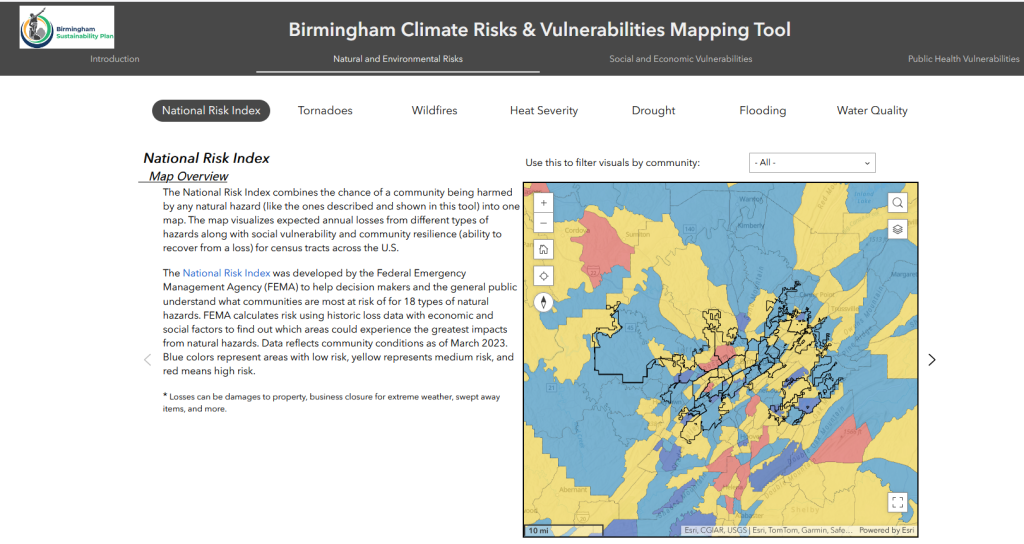
The city has established a Birmingham Sustainability Plan website that lists what the city already is doing to work toward those goals and possibilities for improvement, with strategies for achieving the goals listed for each.
It also includes an interactive Climate Risks and Vulnerabilities Mapping Tool that allows viewers to look up different areas and see the risks the city has assessed as being problems or potential problems. Information about natural and environmental risks, social and economic vulnerabilities, and public health vulnerabilities are presented through the map. For instance, the social and economic vulnerability map shows information such as demographics, employment, transportation, race, income and transportation availability.
Also available is a Climate Pollution Dashboard that shows the results of a 2023 greenhouse gas emissions study that reports where pollution is coming from, with the largest contributor being power production. For each of the pollution sources, a tab details the “Big Ideas” that could address the risk.
Links to the Central Alabama Climate Action Plan spearheaded by the city and published in December, along with information about how the city created the sustainability plan also are available on the site.
Advocates Talk About Work Being Done
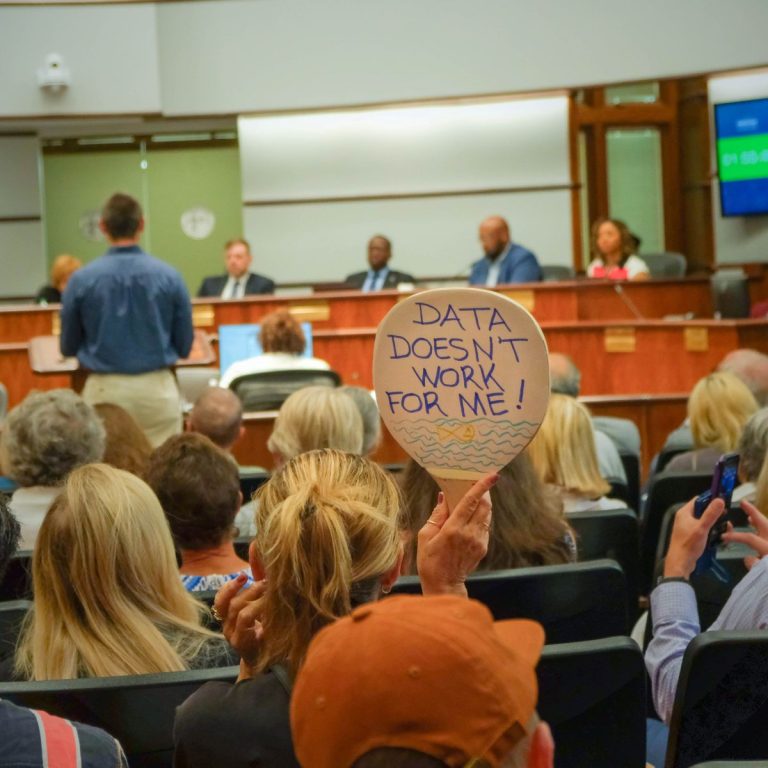
The early evening public meeting drew about a dozen people, most of whom represented agencies that advocate for elements of the plan. John and Sharon Jackson of Roebuck were the exceptions. She wants to see more grocery stores in communities that lack them; he was focused on getting speed bumps to slow traffic in their area.
“Cars went up and down my street, seven to 80 miles an hour, there’s a church on one corner, school on the next corner,” John Jackson said. “Some speed humps would be ideal right there. I know budget is an issue. We already have speed bumps. We have the speed humps. We have the speed humps. Can I say it one more time? We have the speed humps. All we need to do is get some assistance putting them down and getting that done.”
Dr. Amanda D. Clark is founder of From Roots2Harvest.
“We focus on urban agriculture and we’re growing food in Titusville to serve that community,” she said. “We’re working on expanding beyond it.”
Clark said the city’s success in expanding on urban gardens “depends on how much they want to invest in doing it.”
Perry Dowell is deputy director of GASP, the Greater Birmingham Alliance to Stop Pollution. She said air quality in Birmingham has improved since passage of the Clean Air Act in 1970.
“But there are still residents in Birmingham suffering from the effects of heavy industrial pollution, especially in North Birmingham,” she said. “Birmingham has a long history of the steel industry and mining and all of that, and that still lives here today. It’s not over. The people living in North Birmingham deal with industry like coke plants, pipe factories, and all kinds of stuff that ends up impacting their health too.”
Grace Dugger, program director of Cool Green Trees, promotes mitigating urban heat islands within Jefferson County.
“Our goal is to grow and expand the education about the importance of trees and green spaces and how to foster relationships and build these partnerships that help children, the next generation take ownership of their land and understand why it’s important to give back to their own communities,” Dugger said. “When we plant trees in urban heat islands, this is not for our generation, for generations to come.”
As Yuill presented elements of the sustainability plan, he noted the website’s climate pollution dashboard. “This, I believe, is the first city greenhouse gas inventory done in the state of Alabama, which we’re really proud of,” he said.
The chief resilience and sustainability officer cited 2023 statistics on carbon monoxide that’s released in the air and that a negative .05 million metric tons of carbon monoxide is being “basically eaten by our trees. With all the trees we have in Birmingham, it’s (trees are) taking care of .05 million metric tons out of 5.1 million metric tons,” Yuill said. “We’re not going to plant-tree our way out of this problem. Trees are very important, but we can’t plant-tree our way out of this problem.”