Donate today to help Birmingham stay informed.
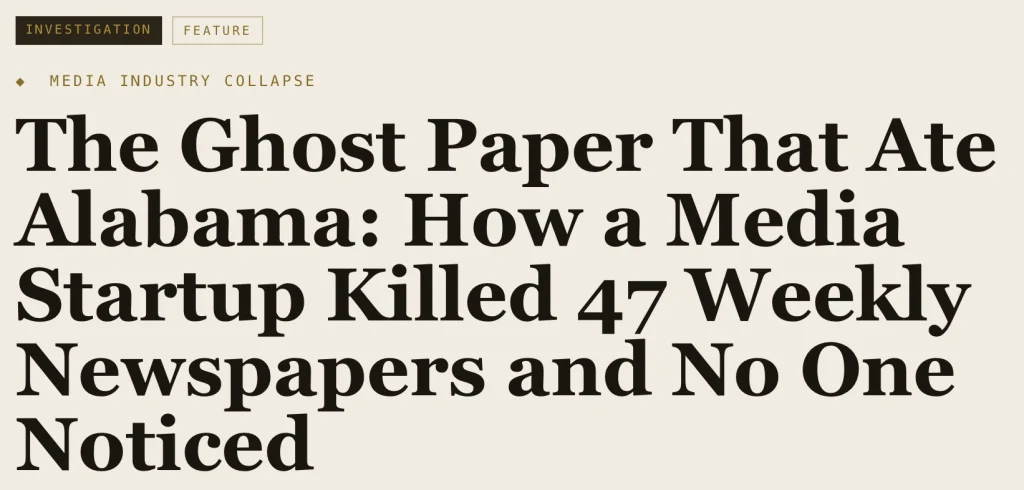
The seemingly legitimate news article, which several people sent to me and was shared on social media by many more, carried a stunning headline: “The Ghost Paper That Ate Alabama: How a Media Startup Killed 47 Weekly Newspapers and No One Noticed.”
Too bad this must-read story turned out to be the most inaccurate AI-generated reporting of all time.
The untrue June 25 article about a (non-existent) Alabama media company that bought and closed 47 weekly newspapers in the state two years ago was removed from the website of “The Editorial” a few days later. An editor’s note said it was removed due to concerns about “fabricated specifics not supported by sources.” Now, the entire website has disappeared.
“I looked around at the reaction and saw people taking it (the article) seriously,” said Alec Etheredge, publisher of The Shelby County Reporter, one of the weeklies that supposedly was purchased, revamped with AI stories in place of reporters and then closed after readers and advertisers abandoned it. In the real world, the Reporter is still owned by Boone Newsmedia, and two days after the article was published, it won the Alabama Press Association’s General Excellence Award in its division for the 20th year in a row.
The Editorial, which showed bios for its reporters that neither I nor anyone else could confirm with online research, produced AI spam for uncertain reasons and shouldn’t have been considered a journalism site. But abominations like this article — when they don’t get recognized for what they are and get spread — are one reason that so few people trust the news media to report accurate information.
A Gallup poll done in September 2025 found that a poll-record low of 28% of respondents had “a great deal” or “a fair amount” of trust in newspapers, TV and radio outlets to report accurately and fairly. That number among Republicans was 8%. Seventy percent of all respondents voiced little or no trust.
A Reuters Institute survey published in June 2026 found that only 25% of U.S. respondents said they “trust most news most of the time.” That is a 5-point drop from a year ago.
Not every number is as dismal as those above. Trust numbers often go up when people are asked about individual outlets (as opposed to their image of the news media in general). Five national outlets rated 40% or higher in both the Reuters survey and a February 2026 survey by YouGov. They were ABC News, NBC News, CNN, the New York Times and the Wall Street Journal. Three newsrooms that routinely and validly get accused of political agendas — CBS News, Fox News and MS NOW — scored that high by Reuters but not by YouGov.
More encouraging is what news consumers say about their local news sources. Reuters found that regional and local newspapers and local TV stations scored 10 points higher in trust than the highest national newsroom. A Pew Research Center survey from September 2025 reported a trust rating of 70% for local news organizations, compared to 56% for national ones. But that confidence in local sources shouldn’t get taken for granted. Ten years ago that 70% figure was 82%.
Local journalists have earned an advantage over national outlets by being familiar to their audiences, going places in their communities, and producing a more balanced mix of positive and negative topics.
“We are in a time when news media gets a bad rap, but local news is (highly) trusted,” Etheredge wrote in an email. “That’s what we pride ourselves in.”
Some reasons for the low trust placed in the press overall are not its fault. Trust in institutions of all kinds is declining, and it doesn’t help to have so many politicians — mostly the president and other Republicans — groundlessly attacking journalistic credibility. As well, too many people judge credibility by whether the facts reported match their preconceived views.
But some reasons absolutely are the news media’s own doing. They make too many mistakes (see Totenberg, Nina, and NPR or ESPN and a murder in the Dominican Republic) and sometimes they let bias creep into news reporting and writing. There’s not enough public explanation of why they do what they do. The diversity of their staffs does not reflect that of their audiences. They report too many stories that their audience doesn’t find relevant. They sometimes get embarrassed by conflicts of interest. OK, I’ll stop now.
There’s still lots of good work out there, every day, that deserves the audience’s trust, even if it doesn’t get it. That includes The Shelby County Reporter and a bunch of other Alabama weeklies that are still very much in business.
If interested, here’s my January 2022 blog post on how to identify fake news. It was written before AI made this task even harder.

Tom Arenberg is an instructor of news media at the University of Alabama. He worked for The Birmingham News and the Alabama Media Group for 30 years. He published this commentary originally as a post on his blog, The Arenblog.
About News is a BirminghamWatch feature that publishes commentary by those who teach the craft and think about the values and performance of today’s journalism. BW shares links to About News columns on Facebook and invites readers to join the conversation there.