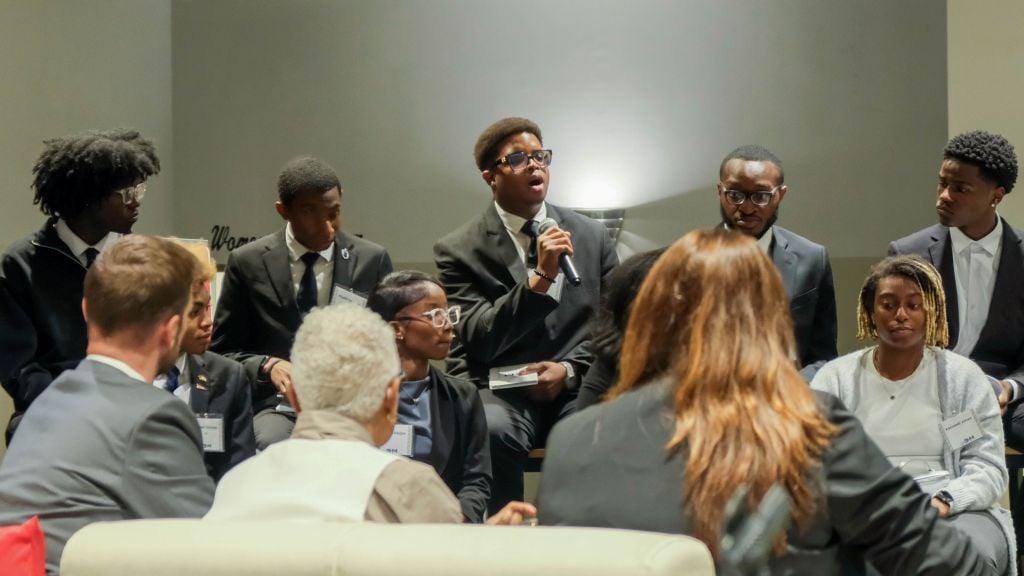
About 120 people gathered Tuesday evening at the Boutwell Auditorium to catch a first glimpse of GoBHM’s multimodal vision for the city.
Project managers Christine Argo, deputy director of strategic projects for the Birmingham Department of Transportation; James Fowler, chief of public infrastructure for the city; and Charlotte Shaw, CEO of the Birmingham-Jefferson County Transit Authority spoke with a panel of 10 young high school- and college-aged residents about why getting around means more than just driving.
“When we talk about multimodal transportation, it really just means giving people more ways to move around the city of Birmingham,” Argo said. “So, whether you’re walking, you’re riding transit, you’re biking, you’re rolling, or you’re driving — giving people more ways to move.”
Project managers said that for decades Birmingham’s public transportation was unbuilt to serve the automobile; now, for the first time in a while, the city has a plan to build anew for people.
The project’s six priorities put people first by expanding travel options, improving access to jobs and everyday destinations, building connected urban villages and corridors, reconnecting neighborhoods and making safety central.
“These urban villages are so important right now because it actually puts the vitality back into urban areas to rebuild them,” said Shaw, “and that’s what’s important because if we rebuild urban areas, we rebuild communities. If we build community, then we can give people access to get to where they need to go.”
Mayor Randall Woodfin framed the effort as foremost a matter of access and opportunity. “Sometimes we can make public transportation such a big thing, but what it really boils down to is providing opportunity.”
“If we want to be a competitive city,” Woodfin added, “and we want to attract industry and we want to attract more jobs for our citizens and our residents, they have to be in a position once they get the job to be able to get to their place of employment. That’s not rocket science. That’s what’s needed.”
GoBHM is intended to be more than a collection of piecemeal bus and bike-lane improvements. The city’s multimodal transportation plan is an overarching program that will guide investment, alter land use patterns, and inform how the city builds infrastructure for the next 10 years and beyond.
“We can’t afford to send buses everywhere all across the city, we just can’t afford it,” Fowler said. “So we’ve got to find those places and actually build those places up from a land use perspective so that there’s density, there’s destinations close together, and then connect those key nodes.”
Public input and coordination with city departments, council representatives and BJCTA shaped the recommendations.
The project managers said city and regional plans, GIS data, crash data from ALDOT, surveys, and engagement events — like this one — were foundational to their efforts.
“Me personally, I believe moments like this are very good, especially for the youth,” said Madison Major, a Ramsey IB High School student, “because I didn’t know about most of the public transportation systems until now, until I sat here now. And so I feel like having more people my age — or even young adults, or whatever age group — coming and just having these conversations and talks as we are now, would be a really good way to just have that involvement and get the word spread around.”
Several pieces of GoBHM have been identified or are already underway: downtown streets are being converted to two-way alongside the Civil Rights Crossroads project; the city is building capacity for quick in-house improvements; and an urban trail from downtown to Legion Field is in development. Birmingham’s BRT and zone-based microtransit are already operating, while public engagement and city–BJCTA coordination have shaped the plan now moving to the City Council for possible adoption.
Councilman Darrell O’Quinn, a longtime advocate for overhauling Birmingham’s car-dependent infrastructure, said the city is heading down the right road.
“One thing that gives me confidence we’ll get this done is the commitment of employees in the Department of Transportation and the other city departments that support it. This isn’t just another project for them. The staff believes in this work; this isn’t just another job.”
Argo said officials are looking to take the report to the City Council as early as December.
“I’m pumped about it all! I’m just excited!” Argo said. “It seems like a lot of things are coming together at the right time, and we’re not going to have to wait years and years and years to get things done.”