
Donate today to help Birmingham stay informed.
Katie Shelton asked how long a closed, unoccupied industrial site might remain in a neighborhood.
“I know some of these buildings have been vacant for years and years and years,” the North Birmingham woman said. “How long (are) businesses just not occupied? How long do they stay? All they’re doing is deteriorating. The building is deteriorating. It’s not doing any good for the community.”
Shelton was among more than 60 people who filled the auditorium of the North Birmingham Library Tuesday night to hear about brownfields, sites where the presence of hazardous substances, pollutants or contaminants from past industrial activity stymies redevelopment.
The city has been assessing brownfields to identify ones that can be reclaimed and redeveloped under a grant it received from the Environmental Protection Agency and is targeting the North Birmingham and Ensley communities. Project manager Tim Gambrel stressed that Tuesday’s meeting was “the beginning.”
“As you all know, there’s a lot of industry in Birmingham,” Gambrel began. “There’s a lot of old industrial sites that are defunct that need to be repurposed. We see that as an opportunity. There’s a lot of work to do. We do this one assessment grant (but) the work’s not done. We want really for this to become a program.”
The project manager said an application for another assessment grant can be submitted when 70% of the first grant is spent.
“This fall, we intend to apply for a cleanup grant to actually clean up a site that we’re going to do some assessment work on this year,” he said. “We hope to kind of continually have that revolving situation where one year we apply for an assessment grant (and) the next year we apply for a cleanup grant. It just goes on and on and on like that.

“There’s a lot of work to do in Birmingham to clean up old industrial sites and to repurpose them into benefits for the community,” Gambrel said. “Really, our big goal is to really develop a program around this EPA grant.”
Norwood’s John Gahan has been waiting to see progress toward revitalizing former industrial sites.
“We have lived in Norwood for seven years and I’ve longed to see the revitalization gain momentum in north Birmingham,” he said. “The city said there was a lot of momentum now, but we will see. Not much actual change has happened yet in our area.”
James “J” Clark, another Norwood resident, said he’d like a former industrial site between Collegeville and Norwood to be developed as part of the Red Rock Valley Trail System. He said the Norwood Neighborhood Association worked on the project 10 or 15 years ago, speaking with the property owner. “We tried to get them to have the property tested for contaminants and they said no,” he said. “It was a heavy industrial site, so it’s got crap on it.”
Sandra Brown said she believed money from a previous EPA effort should have been directed to northern Birmingham. “That money should have been used in Collegeville, Harriman Park, North Birmingham and so forth,” Brown said. “Now you tell me (that money) went outside. Lawson State got money, but we never did hear anything else about the money. No one told us how it was used, where it went or anything.”
Gambrel promised to provide feedback.
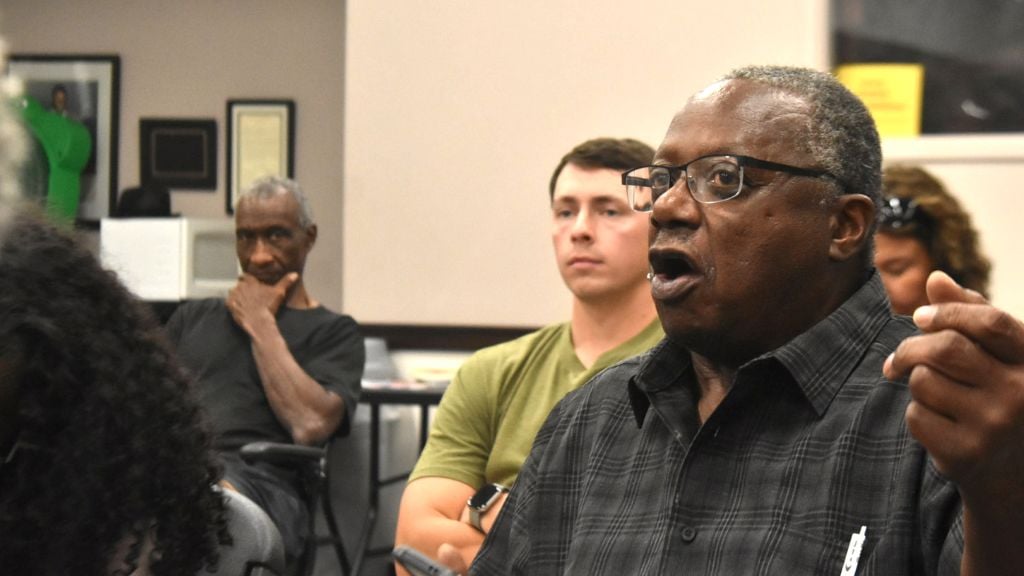
The Rev. Anthony Douglas, president of the Hooper City Neighborhood Association, said he’s attended similar meetings before. He asked for regular reports to residents.
“How often might there be a report that goes back to the neighborhood? Other than that, we just sit idle,” Douglas said. “Then, all of a sudden, it pops up somewhere (that) we’re going to have a meeting. Before we leave today, why don’t we have a reporting time at least every quarter or something, so that the people will know, not just City Hall. We are the taxpayers.”
Gambrel, the project manager, said that is a good idea.
“As part of this assessment grant, we’ll meet with this group three times,” he said. “We’re doing this meeting tonight in kind of an introduction. There’ll be a second meeting that’ll be sort of a follow-up and kind of a progress report. Then the third meeting would be kind of a report out at the end of the program, sort of what did we accomplish. We do intend to come back at least two more times to this same group and kind of talk about progress and talk about what we accomplished.”
“The problem,” Douglas said, “is we’re just talking. We’re tired of talking. There should be a timeline that you set every six months. We’re going to bring you up to date where you’re at. That’s not hard to do.”
Said Gambrel: “We can commit to reporting back. We can do that.”