Science Archives - Page 104 of 136 - BirminghamWatch

Science

Two Dead After Testing Positive for COVID-19 at Veterans Home at Alexander City

Two residents of one of the state’s four veterans homes have died after testing positive for the COVID-19, the state Department of Veterans Affairs stated this morning. The two veterans, 89 and 99 years of age, were among 25 residents who have tested positive for the virus at the Bill Nichols State Veterans Home in Alexander City.  In addition, 18 employees at the Nichols home also have tested positive for the virus, as have two employees at the William F. Green State Veterans Home in Bay Minette. Read more.

Birmingham Commits Another $1 Million to Temporary Worker Program

City Council voted to allocate more funds to the city’s fight against COVID-19. The city’s coronavirus fund was given an additional $1 million for what Mayor Randall Woodfin called “phase two” of the city’s coronavirus response, which involves a temporary “Birmingham Strong Service Corps” worker program focusing on coronavirus testing, access to testing and food insecurity resulting from the pandemic. Read more.

COVID-19 Deaths Reported in Alabama Top 100 as Cases Rise to 3,803

The number of cases in Alabama from the novel coronavirus rose to 3,803 Monday night, with 103 reported deaths, 62 of those confirmed through follow-up tests, according to the state Department of Public Health. Since March 13, 457 people have been hospitalized with the disease. Statewide, 28,486 people have been tested for the coronavirus. Every county now has confirmed cases. Read more.

There Will Be a Day After, but Then Comes the Day After That

UAB officials are starting to look toward the day when COVID-19 cases start to decline in Alabama, but there are no easy answers to what could come next. The most-watched model of coronavirus spread now predicts Alabama will hit its peak April 21, a week from Tuesday, though that date has varied over time. Government and public health officials are watching the numbers to determine when the state can begin the process of getting back to ‘normal.’ When cases do start to drop, those officials will be determining whether they can reopen businesses but require they maintain social distancing, for instance, Dr. Rachel Lee, UAB Hospital epidemiologist, said in a briefing Monday. Lee said people even after restrictions are lightened may have to continue some socially distancing if they want to stay healthy. They may have to cut back on hugging and shaking hands to thwart the coronavirus spread, she said. When movement restrictions are lightened, UAB professionals also will be getting ready for either a slow steady stream of COVID-19 patients or a potential surge of patients. They are planning for the possibility of having to bring COVID-19 operations back to full speed, if needed, Lee said. A decline in the disease does not mean it has gone away; previous pandemics have proved that, she said. Read more.

Surviving A Pandemic: How The 1918 Spanish Flu Changed Life in Alabama

In 1918, Edna Register Boone and her family were living in the rural community of Madrid in south Alabama. “I was 10 years old and my family was the only family in the little town that did not contact the flu,” Boone said. “Therefore my parents became automatic nurses.” In a 2007 interview with the Alabama Department of Public Health (ADPH), Boone described her memories of living through the Spanish Influenza pandemic. Read more.

Schools Faced Social Distancing Hurdles in Meal Prep and Distribution

Preparing thousands of school meals for low-income children while school has been out due to coronavirus hasn’t been easy. Distributing those meals has been another challenge unto itself. That’s why some area school systems have had an on-again off-again relationship with providing meals to children since schools closed statewide about a month ago. Tens of thousands of low-income children in Birmingham and Jefferson County depend on free or reduced-price school meals. This week marks the first full week that both systems will outsource their feeding programs to a local nonprofit. But with the chaos of coronavirus, things got off to a rocky start. Read more.

As COVID-19 Projections Decline, Some Ask for Easing of Restrictions

While state leaders are making plans for re-opening businesses shuttered in response to the COVID-19 pandemic, some would like to see at least a few restrictions eased prior to the planned April 30 timeline. Public health orders in March and April told Alabamians to stay home unless for specific reasons, closed many businesses and put occupancy limits on others, including retailers. While grocery stores can remain open, some smaller retailers had to close. Read more.

Life in a Takeout World

Ella Mae Irby, a fixture at Bogue's Restaurant in Birmingham, talks about the effect COVID-19 has had on her and the restaurant.

Underlying Health Conditions + COVID-19 = Higher Risk of Death

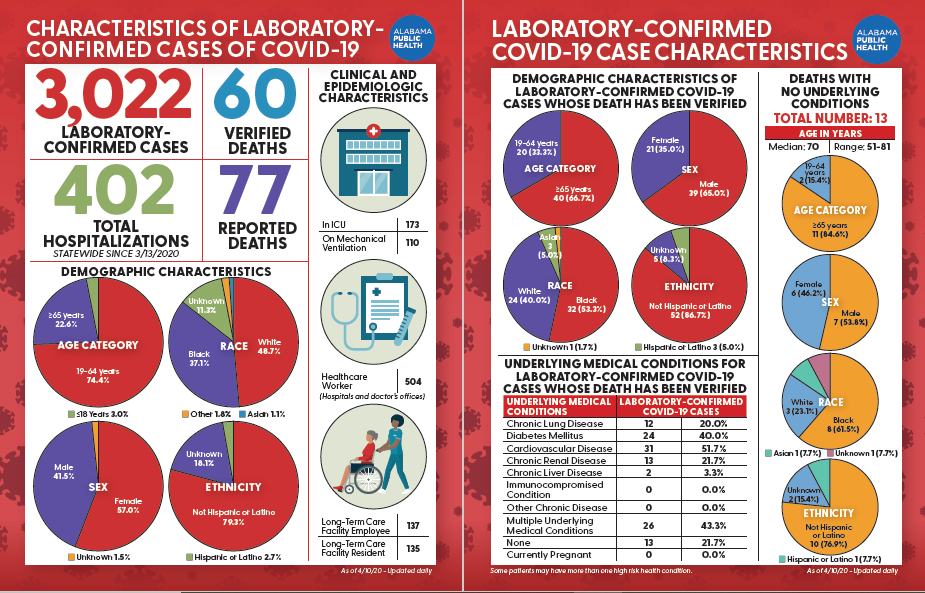
More than half of Alabamians who have been confirmed as dying from COVID-19 also have had cardiovascular disease. Heart disease was the most common underlying health condition among those who have died from the disease, according to data the Alabama Department of Public Health released late Friday. Of the 60 people who were confirmed to have died from COVID-19, 31 also had heart disease. Diabetes was the second most common underlying health condition, with 24 deaths, followed by renal disease, 13, and lung disease, 12. Twenty-six of those who have died from COVID-19 had more than one underlying health condition. But 13 of those who are confirmed as having died from coronavirus had no underlying conditions at all, according to the ADPH data. Read more.