Tag: health care
Two Dead After Testing Positive for COVID-19 at Veterans Home at Alexander City

Two residents of one of the state’s four veterans homes have died after testing positive for the COVID-19, the state Department of Veterans Affairs stated this morning.
The two veterans, 89 and 99 years of age, were among 25 residents who have tested positive for the virus at the Bill Nichols State Veterans Home in Alexander City. In addition, 18 employees at the Nichols home also have tested positive for the virus, as have two employees at the William F. Green State Veterans Home in Bay Minette.
Read more.
There Will Be a Day After, but Then Comes the Day After That

UAB officials are starting to look toward the day when COVID-19 cases start to decline in Alabama, but there are no easy answers to what could come next.
The most-watched model of coronavirus spread now predicts Alabama will hit its peak April 21, a week from Tuesday, though that date has varied over time. Government and public health officials are watching the numbers to determine when the state can begin the process of getting back to ‘normal.’
When cases do start to drop, those officials will be determining whether they can reopen businesses but require they maintain social distancing, for instance, Dr. Rachel Lee, UAB Hospital epidemiologist, said in a briefing Monday. Lee said people even after restrictions are lightened may have to continue some socially distancing if they want to stay healthy. They may have to cut back on hugging and shaking hands to thwart the coronavirus spread, she said.
When movement restrictions are lightened, UAB professionals also will be getting ready for either a slow steady stream of COVID-19 patients or a potential surge of patients. They are planning for the possibility of having to bring COVID-19 operations back to full speed, if needed, Lee said.
A decline in the disease does not mean it has gone away; previous pandemics have proved that, she said. Read more.
Underlying Health Conditions + COVID-19 = Higher Risk of Death
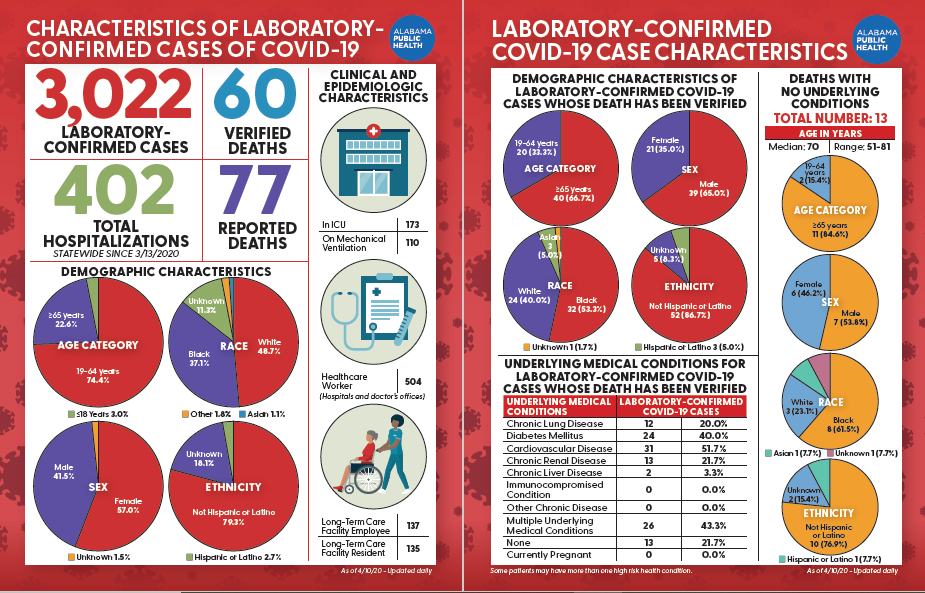
More than half of Alabamians who have been confirmed as dying from COVID-19 also have had cardiovascular disease.
Heart disease was the most common underlying health condition among those who have died from the disease, according to data the Alabama Department of Public Health released late Friday. Of the 60 people who were confirmed to have died from COVID-19, 31 also had heart disease.
Diabetes was the second most common underlying health condition, with 24 deaths, followed by renal disease, 13, and lung disease, 12.
Twenty-six of those who have died from COVID-19 had more than one underlying health condition.
But 13 of those who are confirmed as having died from coronavirus had no underlying conditions at all, according to the ADPH data. Read more.
UAB in International Trial of Inhaled Nitric Oxide for Ventilated COVID-19 Patients

UAB doctors hope a low-risk, FDA-approved drug to be tested at UAB Hospital will serve as a “rescue therapy” for ventilated patients with lungs seriously damaged by the coronavirus, COVID-19. UAB is among the first in the nation to offer inhaled nitric oxide as a potential viable treatment in its intensive care unit for the sickest of these patients, officials said in a telephone news conference. Read more.
Blacks Make Up Disproportionate Percentage of COVID-19 Deaths

Blacks make up a minority of the population of Alabama, but they account for more than half the number of people who have died of COVID-19 in the state, according to the Alabama Department of Public Health.
The department on Wednesday reported that 61 people who tested positive for the disease have died, and 48 of the deaths were confirmed to be the result of COVID-19. Officials were verifying whether the remaining 13 died from the coronavirus.
The figures covered reports through Tuesday, April 7.
The racial breakdown of the 48 who were confirmed to have died of the virus showed that 52.1% were black; 37.5% were white; 7.7% were Asian; and the rest were of unknown race.
Read more.
Virus Tsunami Could Swamp Alabama’s Health Care, Particularly in Rural Areas

• 17 privately run hospitals have closed in Alabama since 2010, seven in rural areas.
• 88% of rural hospitals operate in the red.
• 36 counties have only one hospital, seven have no hospitals.
The COVID-19 pandemic hasn’t hit its peak in Alabama yet, and when it does, it could be a major disaster for the state’s health care infrastruc-ture, according to Dr. Donald Williamson.
“I’m seeing this whole thing as a tsunami,” he said. “Right now, for most of the state, we’re in that pre-tsunami period where the water is actually being pulled out to sea and everything looks quiet. I think you’re already beginning to see the tip of the tsunami in Birmingham and other places, and I think the tsunami will over the next several weeks and months wash over the state, causing great devastation to our health care sys-tem.”
As president and CEO of the Alabama Hospital Association, Williamson has watched Alabama’s medical infrastructure deteriorate over the past 10 years. Read more.
Where to Get Tested for COVID-19

Updated Dec. 12, 2020 — COVID-19 cases are on the rise statewide and predicted to continue increasing into January, at least. The Alabama Department of Public Health has advice if you’re considering getting tested for the disease and locations where the tests are being administered.See a list of screening sites and how to contact each.
COVID-19 Count for Alabama Reaches 2,089, with 55 Deaths

Alabama has recorded 55 deaths of people who tested positive for COVID-19, the state Department of Public Health, reported today. Updated figures show that 39 of those deaths have been officially attributed to the disease, with the remaining 16 still under investigation.
The number of confirmed cases of COVID-19 in the state stood at 2,089.
Jefferson County led with 449 confirmed cases of the disease. The county has recorded 11 deaths of patients who tested positive, with five of those confirmed to be from COVID-19.
Read more.
In Alabama, Renewed Talk of Expanding Medicaid

The spread of the new coronavirus, the resulting strain on hospitals and the possible infusion of federal relief money is rekindling talks of expanding the state’s Medicaid program
For 10 years Alabama has resisted expanding its Medicaid program under the Affordable Care Act, mostly on fiscal grounds. Some estimates show expanding the program to include 360,000 more residents would cost the state about $170 million in the first year alone, with increasing costs going forward.
However, now the state could be in receipt of funds to lighten that bill. The coronavirus economic relief package known as the CARES Act contained $150 billion to help states and local governments recover from the financial impact of the outbreak and specifically included provisions to help states shore up their Medicaid programs. Analysis from the Center on Budget and Policy Priorities shows Alabama coffers could receive as much as $1.7 billion, though much of that is likely to be earmarked toward specific programs.
Read more.
State Health Officer Talks Coronavirus Prep, Potential Surge. ‘We Really Need For People to Stay Home’

Alabama Public Health Officer Dr. Scott Harris spoke with Alabama Daily News on Saturday about the state’s response to the coronavirus, its expected peak and the recent state stay-home order.
Harris is an infectious disease specialist who now finds himself leading Alabama’s efforts to combat the most deadly pandemic in a century. We spoke at length about his work over the past several weeks, how the Department of Public Health is dealing with the unique challenges of COVID-19 and what led to the recent decision to order Alabamians to stay home except for essential needs. Read the Q&A