
Donate today to help Birmingham stay informed.
The City of Birmingham Regional Water Works board will likely request an opinion from Alabama’s attorney general about whether it can legally continue contributing funds to a foundation it established to help low-income residents pay their water bills and repair leaks.
The water works supported the Help 2 Others Foundation from the nonprofit’s inception in 2003 up until last month, when the utility’s attorneys said a new state law that restructured the water works board also bars it from making payments to the foundation. Some board members and the H2O Foundation’s executive director have disagreed with that interpretation of the law.
“The need is so great,” said board member and Jefferson County Commissioner Sheila Tyson, who proposed asking for the attorney general’s opinion. “The smart meters have not been put in. So we still are overcharging.”
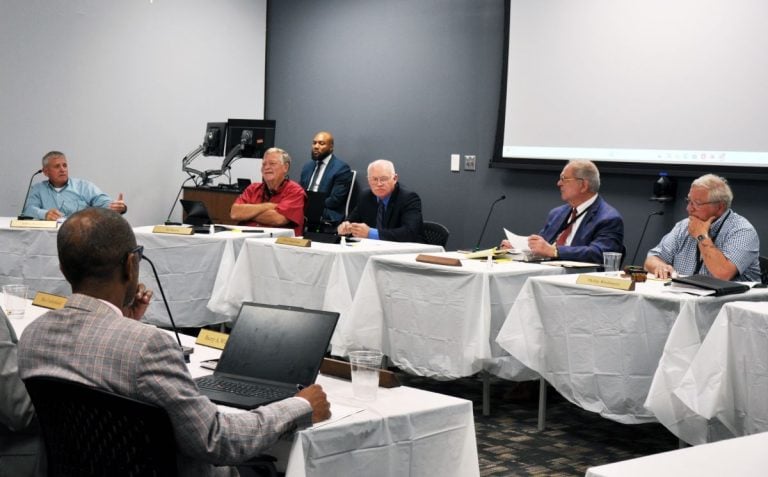
Speaking at a board work session on Thursday, Tyson was referring to long-running customer complaints about inaccurate and unreasonable bills. She said she receives frequent calls about these issues from her constituents and she herself recently received an exorbitant bill.
“I know if I don’t pay it I’m going to get my water cut off, and other people are in the same shape,” she said.
The new law prohibits the water works from making payments for anything other than goods and services required to operate or manage the system.
Jamekia Bies, executive director of the H2O Foundation, addressed the board during a June 24 meeting and said afterward that she thinks the foundation’s work could be interpreted as directly impacting the water works’ operations and management.
“I am coming to you with a plea on behalf of your customers, on behalf of those in the region and in the state that we support to continue providing financial support to the H2O Foundation to provide and ensure that no customer and no household in our community loses that access to water,” Bies told the board.
Board member Jeff Brumlow said the proposed request, which the board could approve at its meeting Monday, also would ask the attorney general whether employees can continue volunteering with the H2O Foundation during their work hours.
How H2O Assistance Works
The water works has contributed $150,000 annually in recent years to the H2O Foundation. In addition, 15% to 20% of the utility’s customers donate to the foundation by checking a box when they pay their bills, Brumlow said. Those donations have totaled approximately $65,000 annually the past three years, according to the water works.
During the same time period, the foundation provided roughly $125,000 to $160,000 per year in assistance to between 435 and 585 households each year, according to a program overview document the foundation sent to the water works in July.
To qualify for assistance, water works customers must meet household income requirements and be at least 55 years old, disabled or have a medical condition that would be “seriously aggravated by a lack of water supply to the home,” according to brochures available at the water works’ headquarters building.
Applicants can receive assistance only one time per year, and the amount cannot exceed $500. Brumlow said the program assists a significant number of customers, with most receiving less than $300.
At board Vice Chairman Phillip Wiedmeyer’s prompting, members brainstormed actions the water works could take to promote the H2O Foundation if an attorney general’s opinion were to prevent direct contributions.
Those ideas included public service announcements, making appearances on local TV news shows and launching a campaign to raise awareness about the foundation, its work and how to donate.
Tyson said the board should make extra efforts to promote the H2O Foundation even if the attorney general’s opinion is favorable to the water works’ making direct contributions.
Barry Williams, an assistant general manager for the water works, said the utility will develop a communication for customers who pay their bills through auto pay because they do not see information about the foundation or requests to donate.
The board also decided to add to Monday’s agenda proposals to:
- Call an executive session, which is closed to the public, to discuss its contracts with lobbyists. In a previous meeting, board member Bill Morris shared that Alabama’s 138 school systems are all represented by a single organization, the Alabama Association of School Boards, which provides legislative updates related to school boards. He suggested that Alabama’s largest water utilities could form a similar consortium and hire one lobbyist to represent them rather than each system paying separate lobbyists.
- Approve a memorandum of understanding with Southern Company Services to conduct a power-pumping study, at no cost to the water works. Board Chairman Tommy Hudson said the study would determine whether the water works could save money by performing certain operations at water-treatment plants and pumping stations at different times of day, when electricity is cheaper.
- Change some upcoming meeting dates due to a conflict with the Labor Day holiday. There was consensus to hold a work session and board meeting on Sept. 2 at 5 p.m. and 6:30 p.m., respectively, rather than on Aug. 28 and Sept. 1.
- Discuss potentially changing its regular meeting schedule. The goal would be to increase the amount of time between work sessions and official board meetings and to reduce the total number of monthly meetings. Currently, the board meets on the first and third Mondays of each month, with work sessions on the preceding Thursdays.