Donate today to help Birmingham stay informed.
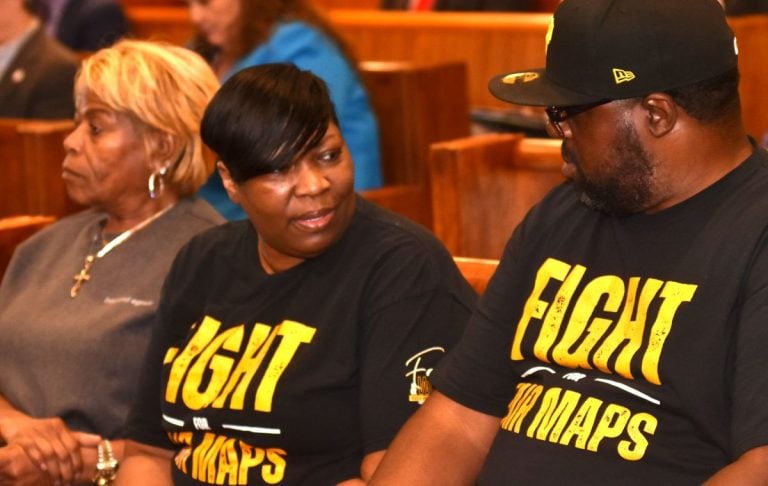
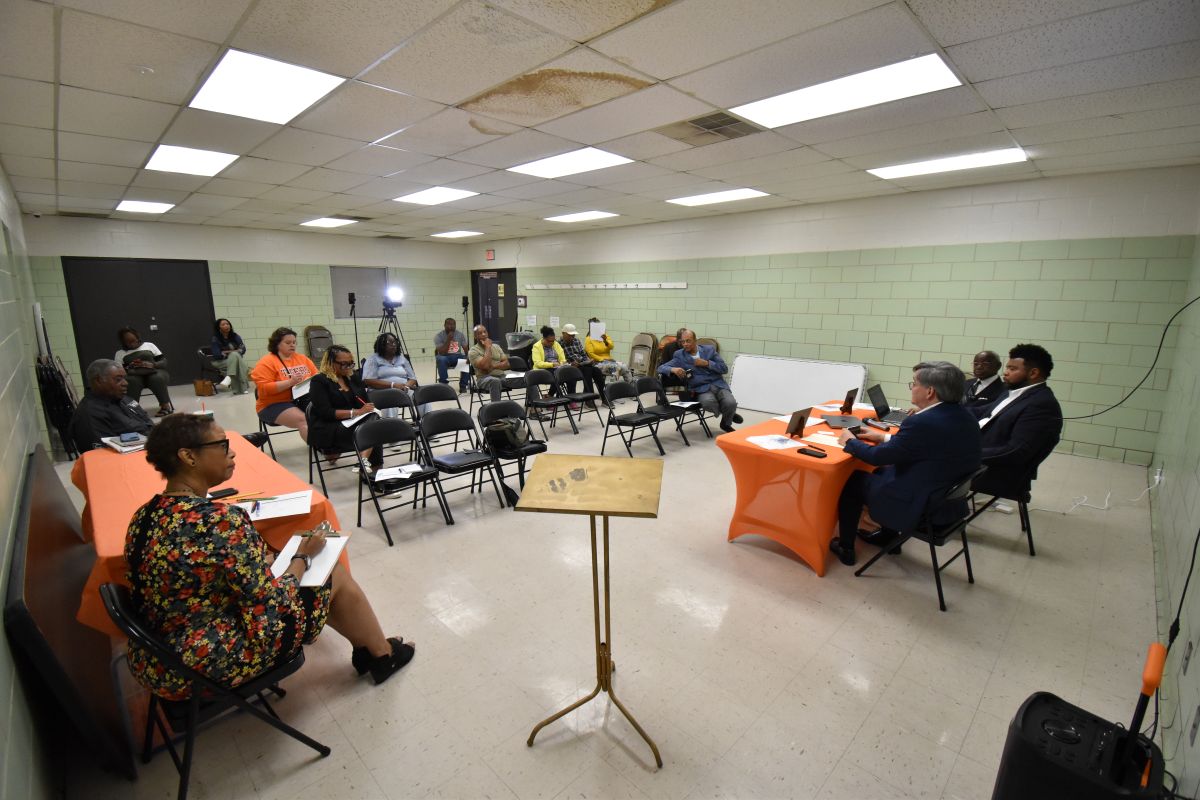
Officials held a Saturday morning town hall in Ensley to detail the legal case against the Jefferson County Commission’s current district map.
The event was hosted by attorneys representing 11 residents who sued the County Commission claiming the district lines it drew in 2021 were unconstitutional. The case, Addoh-Kondi, et al. v. Jefferson County Commission, was combined with a similar suit filed by the NAACP’s Legal Defense Fund, in which Cara McClure is the lead plaintiff.
Lawyers have argued that as Jefferson County’s Black population grew and more Black residents moved into the cities and suburbs outlying Birmingham, county officials redrew the district lines to follow them, keeping them in two primarily minority districts.
Last month, U.S. District Judge Madeline H. Haikala ruled in favor of the local residents, saying the county’s district maps violated the 14th Amendment. In her ruling, Haikala ordered Jefferson County to redraw the districts. The county has asked the 11th Circuit Court of Appeals to grant a stay on the ruling until the case is resolved, arguing that there is not enough time to redraw a map before the 2026 elections.
Speaking to a crowd of about a dozen people at the Ensley Recreation Center Saturday, attorney Richard Rouco said if the county is granted the stay, the legal proceedings that follow it would make it virtually impossible to have a new map in place for the 2026 elections.
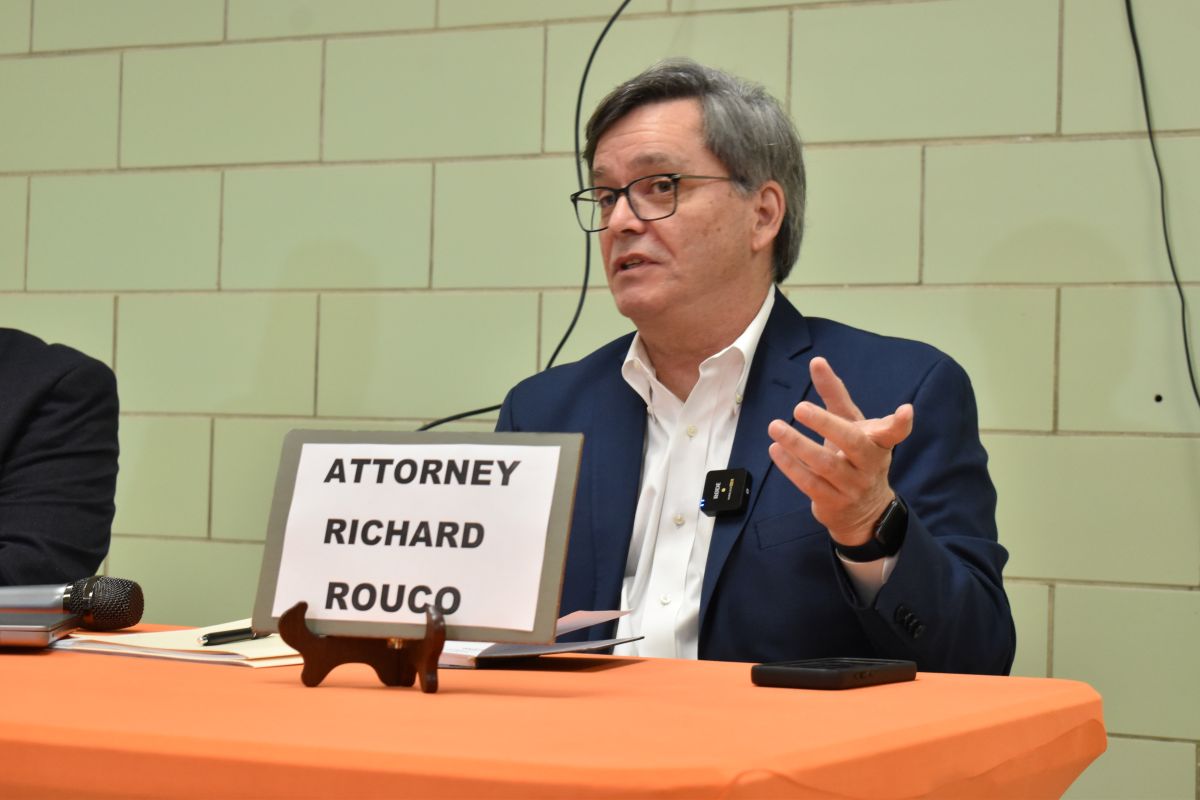
“So what happens in the court of appeals with respect to the county commission’s request for a stay is crucial,” he said.
On the other hand, the County Commission’s lawyers filed arguments with the federal court last week saying that if the ruling isn’t delayed, officials and candidates would not have time to meet their preelection deadlines. In fact, candidates running for commission seats in the 2026 election must live in the district they want to represent by Nov. 3. But without a stay, some prospective candidates can’t be sure which district will include their home by then, they said.
Rouco told the residents that Jefferson County declined to draw a new map that complies with Haikala’s order. However, the Addoh-Kondi legal team had an expert develop a proposal that closely follows the previous district map from 2013 and that makes a substantial effort to keep municipalities from being split into different districts.
James Blacksher, who joined Saturday’s town hall via livestream, is an Alabama attorney who has worked on voting rights cases since 1971. He broke down the proposed map as well as another map offered by the NAACP Legal Defense Fund.
The Addoh-Kondi proposal keeps districts 1 and 2 with strong Black majorities while making District 3 split demographically. Meanwhile, the NAACP’s map puts more Black voters into districts 3 and 4, with 35% and 40% respectively. The NAACP map also splits more municipalities into different districts compared to the Addoh-Kondi proposal.
Rouco said the Addoh-Kondi and NAACP lawyers differ only slightly in their approach to the maps, and he wants to avoid a scenario in which they are advocating for one proposal over another.
“The LDF did a fabulous job. Those lawyers did a fabulous, fabulous job. … When we got to trial, they were knocking it out of the park, and we would not be here today without them,” he said.
| Black Percentage | |||
| Addoh-Kondi Plaintiffs | Legal Defense Fund | Current Map | |
| District 1 | 64.6% | 62.7% | 76.3% |
| District 2 | 64.7% | 57.6% | 64.1% |
| District 3 | 49.7% | 35.0% | 25.8% |
| District 4 | 21.9% | 40.1% | 25.7% |
| District 5 | 13.7% | 13.1% | 13.9% |
Rouco added that he is hopeful the 11th Circuit Court of Appeals will deny the county’s request for a stay. Otherwise, such a delay would mean officials will be using a district map for the 2026 election that a judge has ruled is unconstitutional.
Rouco also reminded the town hall attendees that the Jefferson County case comes amid several recent Supreme Court rulings that have stripped away many federal voting rights protections.
He said the Supreme Court is set on Oct. 15 to hear a case called Louisiana v. Callais that will have major implications on cases like theirs. A bad ruling could effectively do away with the protections of Section 2 of the Voting Rights Act, he said.
“That case may very well decide whether what we do here today has any future,” Rouco said.
U.W. Clemon, a former federal judge and attorney for the Addoh-Kondi plaintiffs, urged the residents at the town hall to voice their concerns about the current district map to the two African American county commissioners. He said those two officials are represented by the same firm as the commission.
“For those black commissioners, y’all ought to be on them like white on rice,” Clemon told the crowd at the center.