Culture
Magic in the Margins: How J.R. Williams Is Reviving Birmingham’s Alt Storytelling Legacy

Donate today to help Birmingham stay informed.
When John ‘J.R.’ Williams was laid off from his corporate job last fall, he decided the moment called for a leap rather than a retreat.
He had spent his career in newspapers, from the copy desk to neighborhood beats, and he still carried the imprint of the Black & White issues in which he had indulged as a child.
“When I was my daughter’s age (7), there was nothing more fascinating you could put in my hands than a copy of the Black & White (a no-longer- existing Birmingham-based alternative newspaper). It was captivating, it was mysterious … . As a kid, you jump right into the comics, and something about that was just irresistible for me and I just wanted to know how people did (it).”
Williams, 41, laughed as he recalled trying to read J.R. Taylor columns, “before I even knew what he was talking about.”
“But the artwork, it really kind of brought together (for a kid who was growing up in Hoover), what Birmingham was really like, so that was an inspiration behind MCR.”
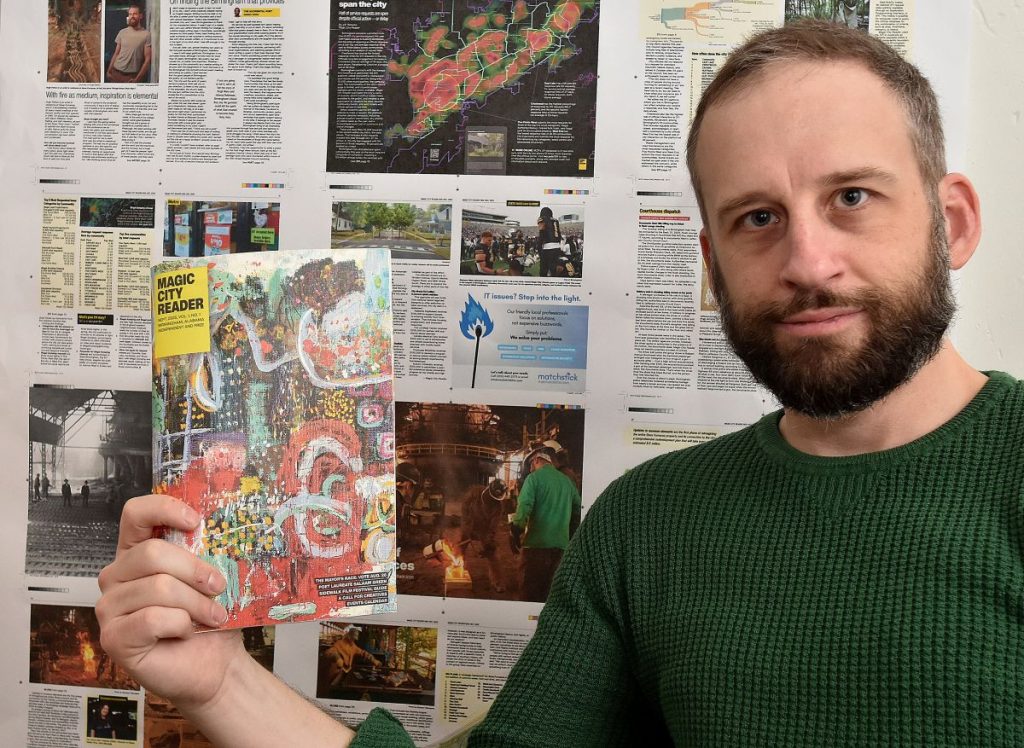
The Magic City Reader is the publication born of William’s childhood curiosity and his belief that Birmingham deserves a free, useful, alternative-style print magazine that showcases the real heartbeat and culture of the Magic City.
“If you look at the landscape, I think people are ready for it (a new alt magazine). I’m somebody who believes that the analog sparks the imagination, and I can really hear it when I talk to people about this,” Williams said. “When I tell people about this new print publication, their first reaction is to offer an idea. You know? No matter what it is — the content, the way it’s distributed, the way it’s printed, what it looks like, the photography, the art — it really gets people’s imagination going.
“I just decided, hey, if there’s any time to do this, it’s now,” he said. “And I just knew that if I were to dedicate the rest of my career to this, that at the very least, the enthusiasm and the demand was there.”
Naming the publication came easily to Williams. He wanted something that honored Birmingham without overstating itself. A title that felt native to the city’s identity and reflective of its alt press tradition. The name needed to signal Birmingham at first glance and still feel timeless on the page. Magic City Reader, he said, checked every box.
“Magic City, to me, seems like it’s the one nickname that’s accepted (by everyone). I think people like it, most people use it and I’ve always known Birmingham to have that nickname,” Williams said. “So to me, it just kind of naturally says ‘Birmingham.’ And ‘Reader’ is deliberate because reader is kind of a traditional name for an alternative publication. The most famous, I guess, would be the Chicago Reader… And if the cover is captivating enough, the reader and the bystander knows exactly what they’re looking at.”
Williams never set out to compete with the noise of digital media. When he talks about the Magic City Reader, he describes it as something operating on a different frequency entirely.
“I don’t really look at it as a challenge to the digital landscape,” he said. “Or to digital media, because it’s not digital media. I’m filling a totally different void.” Williams said the print publication gives something digital media never will: “A print publication doesn’t ask for anything from you, it only gives.”
A Publisher Shaped by the Region
Williams grew up in Hoover, moved to Indian Springs, graduated from Oak Mountain High School, and remembers watching Michael Jordan hit a home run at the Hoover Met. He earned his undergraduate degree in communications from the University of West Florida and went on to complete a master’s degree in writing at Johns Hopkins University. Williams’ education in journalism and time in the corporate world became the training he’d use to fulfill his calling.
“I started right out of college in papers,” he said. “Most of my career has been spent on the copy desk and out and about, listening to people, meeting people, writing stories. It’s an exhilarating way to make a living. All these business strategies were just a caper to continue writing for a living.”
Williams said his love for print began long before his bylines. He remembers sitting with his grandfather, for whom he was named, and watching him unfold the newspaper at breakfast. “Every time I spent time with him, he’d take me out for breakfast, and he’d also have a paper there,” Williams said. “So maybe there’s something there,” he laughed.
A Return to Birmingham’s Alt Press DNA
Magic City Reader springs from Birmingham’s lineage of alternative publications, a scene that shaped how generations learned to understand their city. Williams studied that lineage closely before printing his first issue. He spent time in the Birmingham Public Library’s Research Building reviewing decades of Black & White’s run from the early nineties to 2014. “Their tagline was Birmingham’s City Paper,” he said, “I went through hundreds of copies.”
He had been searching for one specific piece. “I really wanted to find the interview Black & White did with Prince, but somebody had torn it out,” he said, “If anybody has that, I want to read that,” Williams laughed.
The missing pages reminded him how fragile local memory can be and how easily stories disappear if no one protects them. That sense of responsibility is part of what drives the Magic City Reader.
“There’s nothing that’s currently being published that fits the description or definition of what I think people remember (of) alt weeklies. It’s the alternative publication, because for all time, there was the primary broadsheet … and then you have alternative publications. Birmingham has a long history of alternative publications as well, and these are papers that speak to the city’s culture but also cover the news,” Williams explained.
“And because of (MCR’s) elongated publication schedule, because it’s not a daily, we’re able to approach stories in a different way and tell different kinds of stories. And there’s a lot of practical utility to them too. I thought, if I was going to do this, every page of Magic City Reader needs to either inform you, entertain you or help you in some way,” Williams said.
When it comes to bringing back the alt press with a print publication, Williams was asked how he imagined it fit into today’s digital era, and he said, “I don’t feel in competition with other outlets because what I’m doing is fundamentally different,” he said. “It’s not on the internet. I’m trying to provide as much value as I possibly can, and to me, that comes from print.”
He continued, “When you are standing in line at the coffee shop, when you’re in a waiting room or when you are waiting for anything, to be able to look over and see a copy of something that is fresh, is about your city, is entertaining, helpful, and informative, that’s the MCR,” he said. “And I think people have maybe forgotten or have never experienced the thrill of reading an exciting story in print.
A Platform for Creatives
From the beginning, Williams envisioned Magic City Reader as a home for Birmingham’s creative talent. “Half the vision is to pay creative people (and) serve as a venue and an outlet for Birmingham’s writers and artists of any kind to contribute their work and get paid for it.”
He’s already begun that work. The publication features original illustrations, large format photography, artist profiles and visual storytelling that feels distinctly Birmingham. “If you’re a wonderful illustrator, please illustrate a story we’re doing,” he said. “If you shoot Auburn football games and you’re really good at shooting Auburn football games, then by all means (contribute), but Roll Tide,” said the Crimson Tide fan.
He works with photographer Buyisani Tabengwa, a high school friend whose images anchor the Reader’s aesthetic. “He’s a damn good photographer,” Williams said. “It’s a team of two. He takes the photos, and I do everything else.”
Williams designs the Reader with the eye of someone who spent years building pages under daily deadline pressure. “I like things to be colorful,” he said. “I like for things to be clean. I like for it to be evident what you’re supposed to read first and what the most important thing is on the page.”
Even the small details reflect intention. The first issue included a pencil. “I thought it could be an interesting advertising vehicle,” Williams said, “but I also thought it would be useful for people. A pleasant surprise,” he laughed.
Parents, he said, appreciated it for their kids. Others marked up the crosswords and margins. Not every issue will include one. He wants to see how readers respond without it.
Stories That Serve the City
Since every page of Magic City Reader must either inform, entertain or help you in some way, inside the publication, readers can find long-form features, artist spotlights, historical deep dives, a city and county roundup, crime documents reviewed from the Jefferson County Courthouse and an extensive comprehensive events calendar.
“People are excited about the calendar,” he said. “It cannot be easier to understand what’s happening in your city than by looking at a list of events by date and easily find things you can do with your friends or your family.”
While assembling the Reader’s first issue, the Central City resident was deep in another undertaking. Birmingham’s 311 system had become a recurring topic during the mayoral race. He heard residents’ frustrations about slow response times and repetitive requests. He began looking into the data.
“The city’s official portal is not very user friendly,” he said. “But what I discovered is that the vendor makes all of their data public.”
He spent months downloading, cleaning and analyzing thousands of requests made from January through October. “When you start grouping these requests by community, you can identify trends,” he said. “In that time period, there were 8,493 requests created. The city has engaged with 54 percent of those requests. Fourteen percent are marked as closed.”
He built an interactive heat map that reveals patterns of neighborhood complaints and city response. “Every request has geographic coordinates, photos, categories, status changes,” said Williams. “So, I thought, OK. I can make this accessible.”
He asked the city for comment and never heard back. This didn’t discourage him, though. If anything, it sharpened the Reader’s purpose. “I think people deserve to understand how their city functions,” Williams said. “And I want to show them.”
The Vision Ahead
Magic City Reader printed 5,000 copies of its debut issue, which ran in September. Although Williams first imagined a monthly schedule, he realized the work deserved more space. The magazine will now publish every other month, six issues a year.
He funds the publication with personal savings, but long-term sustainability depends on community support. “Ultimately it has to be profitable, or at least pay for itself,” he said.
“I’m a Birmingham native who loves Birmingham,” he said. “I’m just a career journalist and someone who wants to support creative people in town by offering something of value for everyone in the city.”
What Williams is building feels old and new, as it carries the lineage of Birmingham’s alt press and still feels like something created for today’s era. The Magic CIty Reader is personal, it’s public, it’s local, it’s analog in a digital world, and it asks people to slow down long enough to notice their own city again.
The Magic City Reader can be found at select locations in the city.