
Donate today to help Birmingham stay informed.
Some of the students cried.
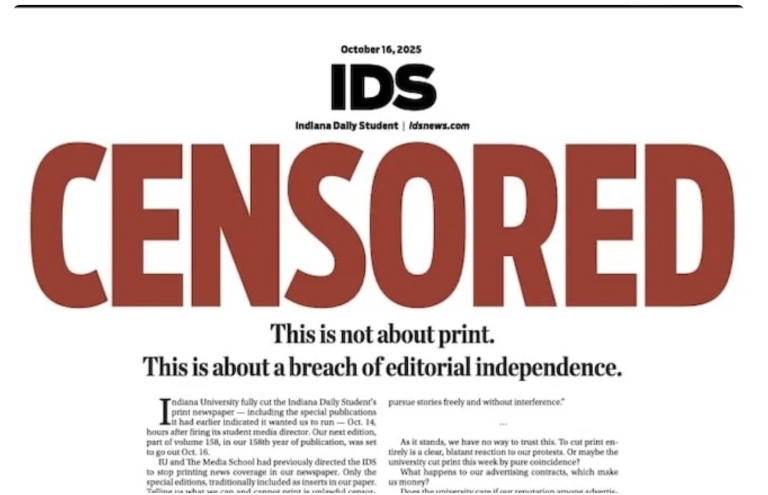
After all, the staffs of two University of Alabama student publications, Nineteen Fifty-Six and Alice magazines, had just been told to their faces Monday that, in essence, their good and hard work didn’t matter and that no one needed to read their stories or opinions. And no farewell editions.
UA abruptly shuttered both university-funded outlets*, saying they violated a July 2025 U.S. Attorney General guideline for how recipients of federal money, such as UA, should avoid unlawful discrimination. The problem with the magazines, the university claims, is that they are produced by and intended for a specific demographic — Black students in the case of Nineteen Fifty-Six and women in the case of Alice.
Magazine alumni exploded, venting on social media, forming a large Instagram chat group, signing online petitions and banging out protest letters.
“The university’s actions are a reckless disregard of student well-being particularly as it relates to minority students who are the most vulnerable population at a predominantly white institution,” Nineteen Fifty-Six founder Tionna Taite** wrote in an email response to my inquiry.
Sophia Surrett, a contributing writer and web editor for Alice for three years, emailed this: “I hope the students know that I, like other alumni, am on their side against this censorship.”
A lot will be lost. Elena Giorgi, who worked for Alice for three years, including as managing editor, wrote to me: “Hundreds of students will lose an outlet for creativity, purpose and passion without them. The College of Communications will lose two enthralling talking points when telling prospective new students about opportunities that align with a CCIS degree. The Office of Student Media will lose access to future national awards these magazines have won in the past, decreasing awareness and success of the journalism opportunities at UA. And the University of Alabama loses out, yet again, in not preserving the identity of students from all walks of life who saw themselves in the pages of Alice or Nineteen Fifty-Six.”
Her work for Alice was personally meaningful, too. She said she’s a better writer, a better leader and a more well-rounded individual because of the magazine.
For Javon Williams, being a contributing writer when Nineteen Fifty-Six was established in 2020 was personally “pivotal.” She gained experience and networking opportunities, and learning about Black culture “helped me greatly in finding my identity while attending a predominantly white institution.” She works in journalism today.
So do Surrett and Lindsey Wilkinson, who worked for Alice for three years including as editor in chief. Surrett said, “I learned so much about myself and the path I wanted to take in my journalism career.” Wilkinson wrote, “My time at Alice served as the foundation of my career.”
So Who’s to Blame?
The flawed thinking that led to Monday begins with the Trump administration, which has spooked universities across the country into thinking, with some justification, that they might lose federal funding for reasons that are unpredictable, political or both.
Further, the Trump administration does not understand campus DEI. Yes, there’s a fair discussion to have about DEI initiatives that grant or used to grant tangible benefits — admission, scholarships — based heavily on a demographic. But to think there’s some unfairness in merely providing supportive publications for a particular demographic as it copes with its very different life experiences is just plain mean.
The university administration completed the sad outcome. The attorney general memo that spawned UA’s concern is only guidance, and an administrator told The Crimson White that the school’s decision was not prompted by a complaint. Such a complete retreat in the face of no imminent enemy — and the willingness to accept the foreseeable public backlash — suggests a lot of fear on UA’s part.
Or perhaps the university is simply and correctly comparing the facts on the ground to the rules in the book? Not really. The university is required “to ensure all members of our community feel welcome to participate in programs that receive university funding from the Office of Student Media,” a spokesperson said in a statement, suggesting that that was not the case with the two magazines. But neither publication has any requirements of race or gender for participation.
Taite, the founder of Nineteen Fifty-Six, said, “When I served as editor in chief for two years, we maintained a diverse and inclusive staff that was hired on merit and not on the basis of race.” The photo editor for three years, for instance, was a white male. Wilkinson and Giorgi said Alice always had male staff or contributors in their time. “We accepted everyone,” Wilkinson said.
If the university is concerned that reputation and informal custom draw only a particular demographic to an on-campus institution, then maybe it needs to rethink the Greek System. But the demographic drawn to that is not one that the Trump administration wants to beat up on.
The university argues not only that magazine participation is too limited but also that the magazines’ audiences are too limited. The alumni disagree with that too. “Women’s issues are everyone’s issues,” said Wilkinson, whose former publication focuses on beauty, fashion, lifestyle and health. Williams believes failure to see the broad relevance of Nineteen Fifty-Six’s content on Black culture and perspectives stems from “the consumer reading it with a closed mind.”
Whatever one concludes about the demographic appeal of Alice and Nineteen Fifty-Six, it’s actually not even relevant. Because except for a few narrow categories, a government agency, like UA, cannot constitutionally restrict a publication based on its content. UA says, unpersuasively, that it’s not doing that. The school “will never restrict our students’ freedom of expression,” the spokesperson said. UA plans a new campus lifestyle publication starting in 2026-27.
Taite remembers the beginning. “UA made promises to their students to be more diverse, equitable and inclusive. School officials such as the VP of student life affirmed that Nineteen Fifty-Six was a puzzle piece in making campus more equitable. How is it that only five years later UA is claiming Nineteen Fifty-Six is no longer needed?”
*The story was first reported by Maven Navarro and Jacob Ritondo of The Crimson White.
**Disclosure: All the magazine alumni in this post are former students of mine.

Tom Arenberg is an instructor of news media at the University of Alabama. He worked for The Birmingham News and the Alabama Media Group for 30 years. He published this commentary originally as a post on his blog, The Arenblog.
About News is a BirminghamWatch feature that publishes commentary by those who teach the craft and think about the values and performance of today’s journalism. BW shares links to About News articles on Facebook and invites readers to join the conversation there.