
Donate today to help Birmingham stay informed.
The Birmingham City Council on Tuesday approved $240,394 for improvements to three Northside neighborhoods affected by the Interstate 20/59 downtown bridge replacement project of 2019.
The money originates from a lawsuit settlement between the neighborhoods near the project and the Alabama Department of Transportation.
Because the projects involve public rights-of-way, the work must be done by the City of Birmingham, according to Colin Alexander, program manager in the Birmingham Department of Transportation.
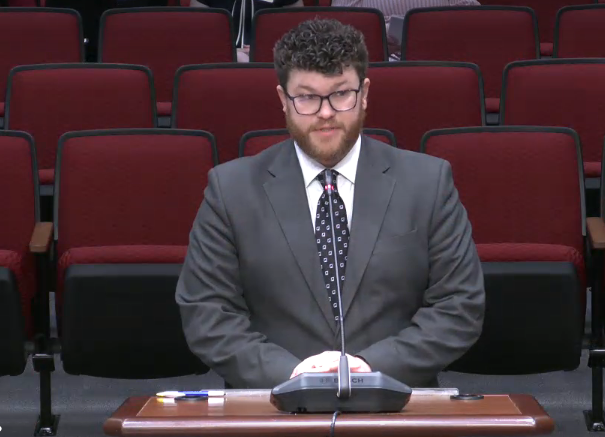
Alexander told the council the projects were chosen by a committee from the three neighborhoods. Those projects include gateways and traffic calming work such as speed cushions in the Norwood neighborhood as well as sidewalk repairs in Druid Hills and Fountain Heights.
“It’s extremely important because we get calls every day about traffic coming in and out of the neighborhoods — truck traffic in particular,” said Councilor Brian Gunn, who represents the Norwood area. “We want to make sure that we worked extensively as the city of Birmingham to make sure that residents are safe, whether they’re cycling, whether they’re walking or driving to and from work or play.”
The council passed the measure unanimously.
Council President Wardine Alexander added that day’s agenda also included a measure accepting a bid for $720,842 in work for a major citywide sidewalk repair project.
The bid came from Global Construction and Engineering Inc. of Birmingham, which the council approved unanimously as part of its consent agenda.
Sidewalk repair has been a major policy priority for Birmingham leaders in recent years. The council in March approved spending $2 million from a $31.8 million budget on such work.
Council Approves New Safety Measures for Nightclubs
The Birmingham City Council on Tuesday voted to add several requirements to the ordinance concerning safety policies for entertainment establishments and clubs.
“Today we’ve revised a lot of the conditions of that ordinance that allows us to redefine some aspects and make sure that we are getting current copies of safety plans as businesses apply for licensing,” said Councilor Hunter Williams, who is a member of the Public Safety Committee, “but also a way, hopefully, that we can archive those safety plans and make sure that when there are incidents, those plans are being followed.”
Those changes approved Tuesday include:
- Defining “late night establishments” as those open to patrons between midnight and 5 a.m. on any day of the week, or those open between 10 p.m. and 5 a.m. on any day of the week that have had one serious incident within the previous 12 months.
- Adding a definition for “serious incident” that includes “shots fired inside the establishment/general vicinity or a physical altercation involving three or more people.”
- Requiring every establishment to provide city officials with a written safety plan, emergency evacuation plan and the current layout including interior and exterior of the business.
- Requiring every establishment to provide a description of training completed by security or other personnel, including conflict de-escalation training.
- Requiring such businesses to have high-definition security cameras with data stored for a minimum of 30 days.
The city statute amended Tuesday is called the Kelvyn Felder Ordinance, in honor of a 21-year-old man who was stabbed to death in 2009 outside a club on Morris Avenue.
The council on Tuesday also set a public hearing to consider revoking the business license of Nana Funk, a nightclub at 708 29th Street South, due to safety concerns.
Officials said the establishment has seen multiple police calls in the past year, including for a shooting inside the club.
The hearing will be May 26 during the council’s regular meeting at City Hall.