
Donate today to help Birmingham stay informed.
If your home or business was built before 1989, lead service lines could be delivering your water, and pipes and faucets containing lead could be inside your house or building. A new federal regulation requires water utilities to replace service lines containing the toxic metal, but that work isn’t slated for completion until 2037.
Property owners and residents can take steps now to protect themselves, their families and employees from the health consequences of drinking water with high lead levels. And if the City of Birmingham Regional Water Works is replacing main pipelines in your area, taking precautions is especially important because this work can temporarily increase lead levels in your tap water to a significant degree if you have lead or galvanized service lines.
“The science is clear: Lead is a potent neurotoxin and there is no safe level of lead exposure,” the U.S. Environmental Protection Agency stated in a press release announcing the Lead and Copper Rule Improvements in October. “In children, lead can severely harm mental and physical development, slow down learning, and irreversibly damage the brain. In adults, lead can cause increased blood pressure, heart disease, decreased kidney function and cancer. If someone is impacted by lead exposure, there is no known antidote.”
This is the third in a series of stories on water line replacement in the Birmingham area.
- Legal, Funding Questions Surround Mandate To Replace Lead Water Lines
- Birmingham’s Water Line Work Can Temporarily Increase Lead Levels in Some Tap Water
In each year after the Lead and Copper Rule Improvements is issued, EPA estimates it will avert up to 200,000 IQ points lost in children, prevent up to 2,600 cases of attention deficit hyperactivity disorder, protect up to 900,000 infants from low birthweight and reduce up to 1,500 cases of premature death from heart disease.
Service lines are pipes that connect individual homes or buildings to main lines, which are the larger pipes under streets that carry water to entire neighborhoods. According to EPA, lead service lines are typically the most significant source of lead in drinking water.
The Birmingham regional water works’ website states that, in accordance with EPA regulations, the utility will replace service lines made of lead or galvanized metal ever downstream of lead pipes – because this material can absorb and release lead – but doing so will take several years. Water works managers said Alabama’s largest water utility doesn’t have authority to work on private property and they’re studying how to replace the section of service lines between meters, typically located near streets, and homes or buildings.
According to managers, 181,193 of approximately 220,000 service lines in the Birmingham regional water works system are non-lead, 338 are galvanized requiring replacement and 133 are lead. The material type of 39,035 service lines remains unknown, and the water works is actively working to identify the composition of those lines, managers said in a statement reads.
To see how the water works currently categorizes customer service lines in its five-county area, view the utility’s service line inventory map.
How To Check Whether Your Home or Building Has Lead Service Lines or Internal Pipes

Birmingham’s regional water works mailed letters in November to residents and owners of structures built before 1989 notifying them of their service line material type, if known, and, if not, instructing them to examine their pipes to determine material type.
EPA provides a step-by-step guide to quickly learn whether your home or building has lead service lines. The process involves locating your service line, noting its color and using a key or coin to scratch any pipes that are gray.
If the material is hard to scratch and a magnet sticks to it, it’s likely made of galvanized metal. If it is soft and a magnet doesn’t stick, it’s likely lead. Your water utility or a licensed plumber can confirm the service line material type.
Galvanized metal pipes could pose a serious risk as well. That’s because some galvanized metal pipes are lined with lead and because galvanized pipes that have been connected to lead plumbing can trap lead on their inside surface and periodically release those bits of lead, even after lead plumbing is removed, according to EPA.
Birmingham’s regional water works is requesting customers inform the utility of their service line type, and you can do that here.
The service line typically ends at your home or building’s main shutoff valve, usually located in a basement or crawlspace just inside the front or side wall. Some buildings could have lead or galvanized metal lines extending farther into the structure. You also can check those lines using the color and scratch tests.
What To Do If You Have Lead or Galvanized Lines
 If you have lead or galvanized pipes, EPA states you should take actions to reduce exposure to lead in drinking water. Here are some steps:
Have your drinking water tested. Birmingham regional water works’ customers can request a free water test by calling 205-244-4375.
Bathing and showering should be safe for adults and children, even if water contains lead, EPA states, because human skin does not absorb lead.
Get children and possibly others tested. Family doctors, pediatricians and health departments can provide this testing.
Filter your water. Use a water filter that is ANSI/NSF 53 certified for lead removal. Upon request, Birmingham’s regional water works offers pitchers with such filters to residents with lead service lines or galvanized service lines downstream of lead lines, said Mac Underwood, general manager of Birmingham’s regional water works.
To be effective at reducing lead to certification levels, filters must be properly used and maintained. Read and follow the instructions and replace filters as directed. Do not run hot water through filters.
Flush your water before drinking. If your tap water hasn’t been used for several hours, EPA advises flushing the line by running water through a high-volume tap before drinking or cooking.
Birmingham’s regional water works tells customers to flush taps for at least five minutes before drinking or cooking if tap water hasn’t been used for more than six hours. Customers with known lead service lines and homes/buildings far from the street might need to flush longer.
Ways to flush water from a high-volume tap include taking a shower, doing laundry or washing a load of dishes, EPA states. The agency suggests filling containers with water after flushing to use later for consumption.
Use only cold water for cooking and drinking. Do not cook with or drink water from the hot water tap. This is especially important when preparing baby formula. Hot water can dissolve lead more quickly than cold water, according to the EPA. Lead also can settle and concentrate in hot water tanks, Birmingham’s regional water works states. If you need hot water, draw water from the cold tap, then heat it.
Clean faucet screens (aerators). Aerators can collect particles from lead plumbing and should be removed and cleaned on a regular basis, according to the water works. The utility states this is particularly important after household plumbing work and repairs. Flush cold-water lines for five minutes after removing aerators.
Decide whether to hire a plumber to remove your lead or galvanized metal service line or to wait for your water utility to do it. Under the EPA’s LCRI, public water systems have until 2037 to replace all lead service lines and galvanized metal service lines ever downstream of lead lines. But whether Birmingham regional water works’ customers will have to pay for it is currently unclear. You might want to hire a plumber to go ahead and replace these service lines.
Check for other lead-containing products in your home or building’s plumbing system. Interior pipelines, solder and plumbing fixtures, especially those manufactured before 1989, could contain high lead levels. Consider hiring a licensed plumber check for all possible lead sources.
When choosing replacement faucets, look for certification marks indicating products are lead-free.
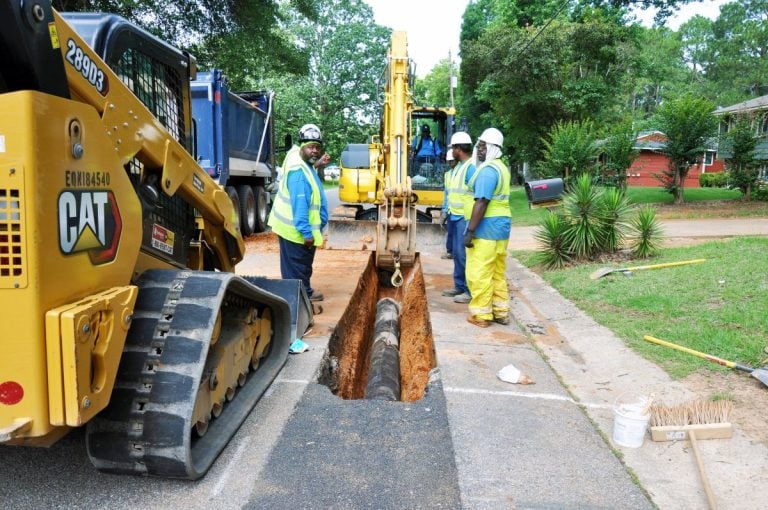
Take more precautions after work on your water lines. As part of a project to upgrade aged main pipelines, Birmingham’s regional water works has been replacing the portion of service lines between main lines and meters as well as a small section of service lines on the other side of the meters, Underwood said. This is called a “partial service line replacement,” and it can significantly increase lead levels in drinking water due to the pipes being disturbed, according to health research.
When utilities partially replace lead service lines, EPA currently requires them to: provide notification to affected residences within 45 days prior to replacement about the potential for elevated lead levels and measures to minimize exposure; include an offer to collect a tap sample for lead testing within 72 hours of replacement; and provide test results within three business days after receiving results.
Approximately 55 days before main-replacement projects, Birmingham’s regional water works notifies customers who have lead, galvanized or an unknown service line material, managers said, and delivers water pitchers with filters to be used during and after construction.
Health experts recommend residents take additional steps after lead or galvanized service lines are fully or partially replaced. In addition to the daily flushing and filtering measures, residents should do a full-house flushing, which includes turning on faucets starting at the lowest level and working upward, letting them run for at least 30 minutes and turning them off starting at the highest level and working downward. After replacement of lead or galvanized pipes, these steps should be taken every two weeks for three months. Find detailed instructions listed here.
To learn more about how to protect yourself and others from lead in drinking water, see the water works’ Water Customers Guide to Lead Safety and EPA’s web page with information about lead in drinking water.

Testing and Results
The Birmingham regional water works’ website states the utility’s water is lead-free when it leaves treatment plants but could be exposed to lead in the distribution system.
The water works “conducts water-quality tests throughout the system, including customer taps at known lead service line locations,” Underwood said. “We have not detected any high levels of lead in the system. Our water treatment process includes active corrosion control to protect against the potential for materials to leach into the water from service lines.”
Corrosion control treatments form a protective layer inside pipes that reduces deterioration that can release lead into drinking water.
EPA measures the effectiveness of corrosion control treatment in water systems through its lead action level. EPA requires water systems to test for lead at the tap in certain homes, including those with lead service lines. If 10% of samples have water concentrations that are greater than the action level, the system must take steps such as public education and lead service line replacement.
As of Nov. 1, 2027, the LCRI will lower the action level from a 90th percentile of 0.015 mg/L to 0.010 mg/L.
The most recent lead testing at Birmingham regional water works’ customer taps for compliance with federal regulations was from June to September 2023. EPA and the Alabama Department of Environmental Management currently require the water works to conduct such testing every three years, and the next round of sampling is scheduled for June 1 through Sept. 30, 2026. In 2023, the 90th percentile lead level was 0.003 mg/L, and one sample exceeded the action level, per the water works’ 2025 Consumer Confidence Report. The range of the system’s lead testing results were not detectable to 0.033 mg/L.

Monitoring Violations
That 2023 testing received an EPA monitoring violation because it did not meet the requirement for 50% of samples to be taken at locations with lead service lines. Thirty-seven of 79 samples, or 46.8%, were collected from locations with lead service lines. A notification about the violation is included in the water works’ 2024 Consumer Confidence Report.
“During January 2023-December 2023, BWWB failed to conduct at least 50% of the Lead and Copper sampling at lead service lines and therefore cannot be sure of the quality of your drinking water during that time,” the report states.
Asked whether Birmingham’s regional water works has tested for lead at customer taps since the 2023 report, managers said in a statement that the utility “conducts water testing as required by state and federal agencies.”
The utility’s 2016 compliance testing for lead also violated monitoring requirements, and the water works entered into a consent order with the Alabama Department of Environmental Management in 2019 as a result. The violation involved sampling locations as well as not maintaining an adequate inventory of lead service lines and sites that are most likely to have high lead levels in their tap water.
A spokesperson for the Alabama Department of Environmental Management said the water works has not incurred a lead and copper action level exceedance, as defined by the EPA, in the past 10 years.
Erik D. Olson, senior strategic director for health at the Natural Resources Defense Council, said testing that only occurs every few years, as has been the case with Birmingham’s regional water works during the past five years, could provide false assurance because of the periodic way lead is typically released from service lines and plumbing. Even turning on a faucet quickly or using a high volume of water could significantly change lead levels, he said.
“So you can test today and find no lead or very low levels of lead and tomorrow very high levels,” he said.
Slight changes in water chemistry because of storms, water main breaks, runoff and changes in water treatment or disinfection byproducts also can alter lead levels, Olson said, adding that this has happened in cities including Syracuse, New York; Washington, D.C.; and Flint, Michigan.
“We strongly encourage utilities to do ongoing, regular, extensive monitoring for lead,” he said. “If a utility really does have as its top priority protecting their residents and citizens, having an ongoing testing program for lead in tap water would be part of that.”
The LCRI will require more frequent testing than EPA currently requires, and some states already mandate testing more often, Olson said.