Donate today to help Birmingham stay informed.
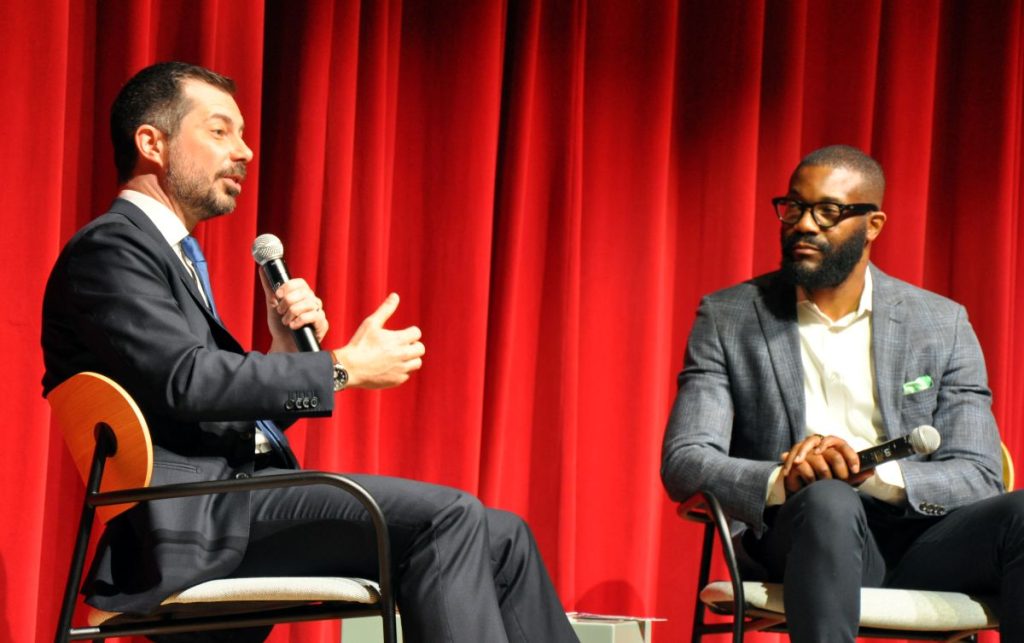
In a moment when Americans are being buffeted by waves of uncertainty and abuses in national politics, positive change can come from the local level, former U.S. Transportation Secretary Pete Buttigieg said Monday during a town hall meeting with Birmingham Mayor Randall Woodfin at a packed Carver Theatre.
“So much of our salvation will actually be coming from the local, where we see people who are in a world of real news, not fake news … people know what’s going on in their communities,” said Buttigieg, who served as mayor of South Bend, Indiana, for eight years before running for president in 2020. “And in a world where we are pulled into environments that are not online, but exquisitely offline, like this room, where people can come together, firm in their values, and try to deliver for one another.”
The discussion covered economic opportunity, housing, transportation, immigration, the role of local leadership and the future of the Democratic Party as Buttigieg and Woodfin answered six questions event organizers said they distilled from more than 70 questions attendees submitted.
Buttigieg mentioned the $14.5 million in federal funding the Transportation Department allocated to Birmingham’s Fourth Avenue Historic District, where the Carver Theatre is located, while he was secretary. The grant money will be used to convert Fourth Avenue North, the main thoroughfare of the city’s historically Black business district, from a one-way street back into a two-way street, to increase access to businesses.
“Those dollars weren’t given,” Buttigieg said. “They were earned. We selected that and some of the other excellent projects in Birmingham for funding because Birmingham demonstrated that this community was prepared to put those dollars to good use.”
Buttigieg praised leaders in local offices as the stewards of the spaces where trust is built. Local politics are not so locked in partisanship and ideology, he said, but they’re more difficult emotionally because local leaders have to deal with each other’s humanity.
“It’s also government at its best, and if we could get Washington to begin to work a little more like our best-run cities and towns instead of the other way around, our country would be much better off,” Buttigieg said.
Transit Needed for Access to Jobs
In response to a question about what the future of transportation looks like, given that in many parts of Alabama, owning a car is necessary to having a job, Buttigieg said public transit and new technology offer solutions.
“If we want people to be able to participate in the economy, we’ve got to make sure that there are ways to get to where you need to be that don’t require you to take 2,000 pounds of metal with you in the form of a car,” he said.
Public bus systems no longer have to be tied to hub-and-spoke routes, where passengers must go through the city center no matter their destination, he said. That’s because technology makes it possible to know in real time how many people need to go where and to adjust schedules.
“We can do things that we couldn’t do 10 or 20 years ago, and we need to put in the funding,” Buttigieg said.
Woodfin pointed out the Birmingham-Jefferson County Transit Authority is utilizing this technology. The transit authority partners with Via Transportation, which manages an on-demand, micro-transit program with services similar to shared rides through Uber and Lyft.
Woodfin also noted Alabama’s lack of state funding for public transportation — it’s one of only three states that don’t provide such funding — and some legislators’ efforts to change that.
A 1952 amendment to Alabama’s constitution makes it illegal to use state gasoline tax revenue for anything other than building and maintaining roads and bridges. All of Alabama’s neighboring states use gas taxes to fund public transportation.
“We have legislators who represent us in the Jefferson County delegation who have introduced legislation to change that state law, and they’re batted down every time,” Woodfin said. “But our delegation is doing its part to get the state to see we’re doing this wrong, that if you want to change the economy, you have to actually invest in and support public transportation.”
Minimum Wage and Economic Opportunity
Woodfin had a similar response to a question about what tools city and federal leaders have to expand economic opportunity when minimum wage in Alabama remains at $7.25 per hour.
A previous city council several years ago incrementally increased the minimum wage while the state Legislature was in session, he said.
“A bill — probably one of the most fast-tracked bills I’ve ever seen pass — went statewide and not only didn’t allow the city of Birmingham to unilaterally increase minimum wage but stopped any city in the state of Alabama from doing that.”
Buttigieg said the federal minimum wage has been stagnant for a long time, too. When the federal government doesn’t step up, states should do that, he said. And when states won’t, local governments should, he continued, acknowledging situations like the one Birmingham faced when it tried.
Alabama is one of five states that have no state-mandated minimum wage, so employers must abide by the federal minimum.
“States that have their state-level minimum wage higher than that federal floor tend to do better,” Buttigieg said.
He said every complicated policy problem should be approached with a simple principle.
“And the simple principle here is one job ought to be enough,” he said. “You get up, you go to work, you do good work — you should be able to expect wages and benefits that are enough that you can be confident of a roof over your head and food to eat. And, by the way, a vacation every now and then.”
Blight Adds to Housing Affordability Problem
The housing discussion centered on rising costs, blighted properties and how cities can grow while protecting affordability and stabilizing neighborhoods.
Buttigieg said creative solutions in the realms of land banking and community redevelopment can help.
Some properties lose so much value that whoever owned them, “which is maybe an investor 1,000 miles away, who only knows that home as a line on a spreadsheet, decides it’s cheaper to just completely walk away from it, not even answer the mail about it, rather than to go through all the trouble of selling,” Buttigieg said. “That actually happens.”
“It’s happening right here and right now,” Woodfin said.
Buttigieg told Woodfin federal and state policy should be empowering city leaders to pursue those property owners. Woodfin highlighted efforts of the City Council and state representatives to address those issues.
He said councilors helped Jefferson County’s delegation in the state Legislature craft a package of bills meant to stabilize communities and help them grow. One bill would require property owners to identify themselves instead of hiding behind LLCs, and the other involves a community land trust that would allow creative public-private partnerships, he said.
Immigration Building Bridges on Immigration Policy
Buttigieg said building bridges across political divides can help support immigrant communities and shape immigration policy.
Almost everyone agrees the country needs borders and immigration laws that are enforced, he said.
“I think that’s what a lot of people thought they were voting for,” he continued. “They also thought they were voting for a government that would find someone who was dangerous, who was a violent criminal, who had convictions, and deport them — not somebody who has been in the country for years, raising children, paying taxes, often opening a business, doing right by their community.”
Buttigieg was referring to the Trump administration’s immigration crackdown in cities across the country that has led to mass deportations and the arrests of people in the United States legally.
He encouraged people to talk across political divides to build a coalition that “does not have to be all about Democrat versus Republican, but really it’s about right versus wrong, and it’s about how we treat each other.”
Woodfin said fear among immigrant communities in Birmingham and throughout the state has caused families to pull children out of schools.
“This problem affects families who are legally here as well, because when you have that amount of fear and anxiety, created from that amount of hate, you’re driving away families,” he said. “And it affects not just school systems. It affects local business. It affects the economy.”
Future of the Democratic Party
Buttigieg said the key word in a question about what it would take to build a strong and winning Democratic coalition was “coalition.”
“A coalition is not uniform,” he said. “A coalition is not everybody with the exact same interests or the exact same backgrounds … . It has to be broad.”
The party needs to be relentless in inviting into this coalition all Americans who agree the country can do better, he said.
On about 10 of the issues people say are the most important to them, two-thirds of Americans agree with what’s generally considered the Democratic position, Buttigieg said. They believe workers should be paid more and have better benefits, universal background checks for gun purchasers make sense, everyone should have health care, and there should be more lawful immigration and less unlawful immigration, he said.
“If we have about two-thirds of the country mostly agreeing with the Democratic view on most big issues, how in the world is it that we can’t seem to get to 51% in a lot of these elections?” Buttigieg asked.
One answer he suggested is long-term structural reform to the Electoral College, under which he said voters in only 10 or 12 states wind up deciding presidential elections. “In any other election I have ever seen in my life, from student council to condo board president to dog catcher to governor, the person who gets the most votes gets to win,” he said.
Money in politics is another issue, but many people say nothing can be done because it would require a constitutional amendment, Buttigieg said.
“This country has changed its Constitution 29 times through the amendment process,” he said. “We once changed our Constitution so you couldn’t get a beer. Don’t tell me we can’t update the Constitution to clarify that a corporation is not a person and that money is not speech.”
In the short term, if most people agree with the Democratic Party on policy but votes don’t reflect that, Buttigieg said the party needs to ask itself what kind of communicators it’s putting forward.
“I think we need communicators who can build bridges, communicators who are unafraid to go into conservative spaces, communicators who can approach the other side with firm conviction and respect,” he said. “At the same time, I would like to see more local leaders brought into national politics who have that kind of spirit of problem solving and that kind of attitude.”
Full House at the Carver
The 452-seat Carver Theatre was full for the event, which was organized by Blueprint Alabama, a political action committee with an aim of turning Alabama blue politically.
Several state legislators and gubernatorial candidate Doug Jones were in attendance. Thunderous applause erupted from the audience multiple times.
Birmingham resident Cassondra Redd, who is visually impaired, said cuts to programs that benefit the disability community are among her top concerns, and she wanted to hear Buttigieg’s ideas for turning things around.
“He did touch on several things about that, and that was health care, housing and transportation,” Redd said. “Those things affect people in the disability community a lot, so I’m glad he acknowledged that those were issues, not only in our state, but in the United States as well.”