Donate today to help Birmingham stay informed.
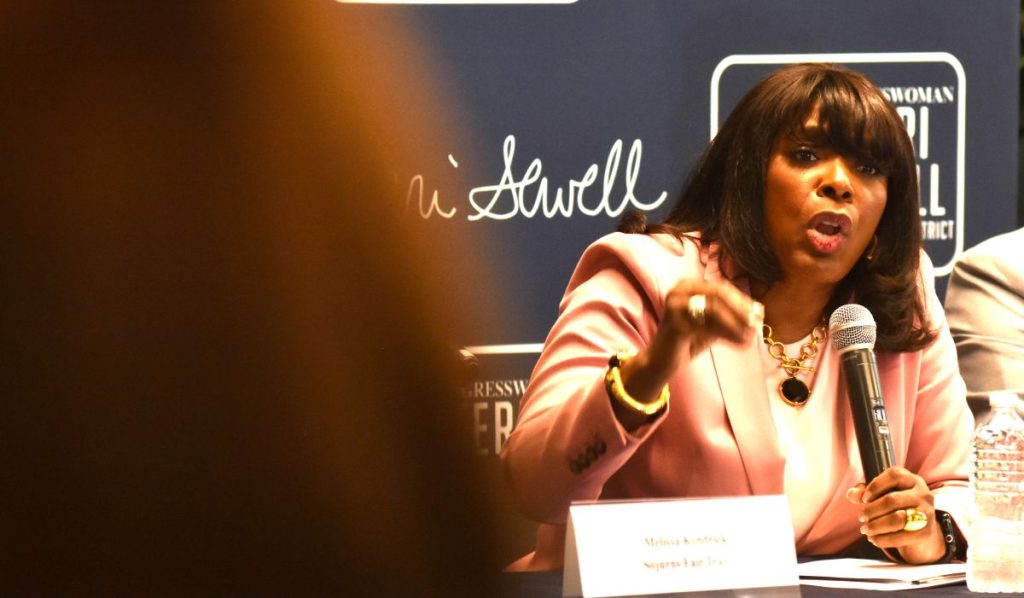
U.S. Rep. Terri Sewell said Tuesday that while she thinks the Department of Homeland Security needs comprehensive reform, she splits with popular opinion among Democratic leadership and does not support blocking DHS funding.
Sewell said she refuses to give ICE a “blank check” to continue its immigration crackdown as it has been conducted, but she does not support abolishing the agency. ICE, she said, must instead be subject to “common sense” reforms to set clearer “guard rails” on its actions.
Sewell spoke during a Tele-Town Hall to update constituents in her 7th Congressional District on how federal policy is affecting Alabama’s small businesses, health care coverage and immigrant communities.
Carlos Alemán, CEO of ¡HICA!, was among her guests at the meeting. Sewell and Alemán agreed that enforcement actions and local partnerships with federal immigration authorities have stoked fear among immigrant families.
The state House of Representatives on Tuesday passed HB 13, which specifically would allow any state or local law enforcement agency to enter in an agreement with federal officials for immigration enforcement and regulate how suspected and confirmed undocumented immigrants are held in jails.
Democrats in Congress are refusing to pass a DHS budget without immigration enforcement reform and Republicans are refusing to pass partial funding for critical systems, leading to affects such as extreme waits at airports because Transportation Security Administration workers are not being paid.
Alemán encouraged constituents to visit ¡HICA! for any concerns or legal advice about immigration. The nonprofit organization supports immigrant and Latino communities in Alabama by providing legal assistance, education, family services and programs that promote economic opportunity, including small-business advising and community advocacy.
Small Businesses Suffering in This Economy
Affects on small businesses and taxpayers was a theme throughout the town hall, which also included comments from Patrick Murphy, Goodrich Endowed Chair for Innovation and Entrepreneurship at UAB; Keshee Dozier-Smith, CEO of Rural Health Medical Program Inc.; and Theodore Badami, IRS liaison for District 7.
Murphy, an economist, explained that while national economic indicators show moderate growth of about 2% to 2.6%, many small businesses in Alabama are still struggling with high costs and slower job growth in trade-sensitive sectors.
New across-the-board tariffs increased costs for many small businesses in Alabama, with about 42% reporting higher expenses, particularly in retail and manufacturing. These federal trade policies will translate into higher prices, reduced staffing and slower economic activity in communities that depend on small business employment, he said.
Dozier-Smith said Rural Health Services operates 10 health clinics and one mobile health unit for primary care, pediatrics, dentistry, pharmacy and mental health services.
She expects her already strained clinics — which offer care to the insured and non-insured — to be hit hard by the expiration of ACA premium tax credits. When coverage declines, clinics face more uninsured patients, patients who have delayed treatment and patients with worsening chronic conditions, which puts even more financial strain on small businesses and already limited rural health care systems, she said.