Donate today to help Birmingham stay informed.
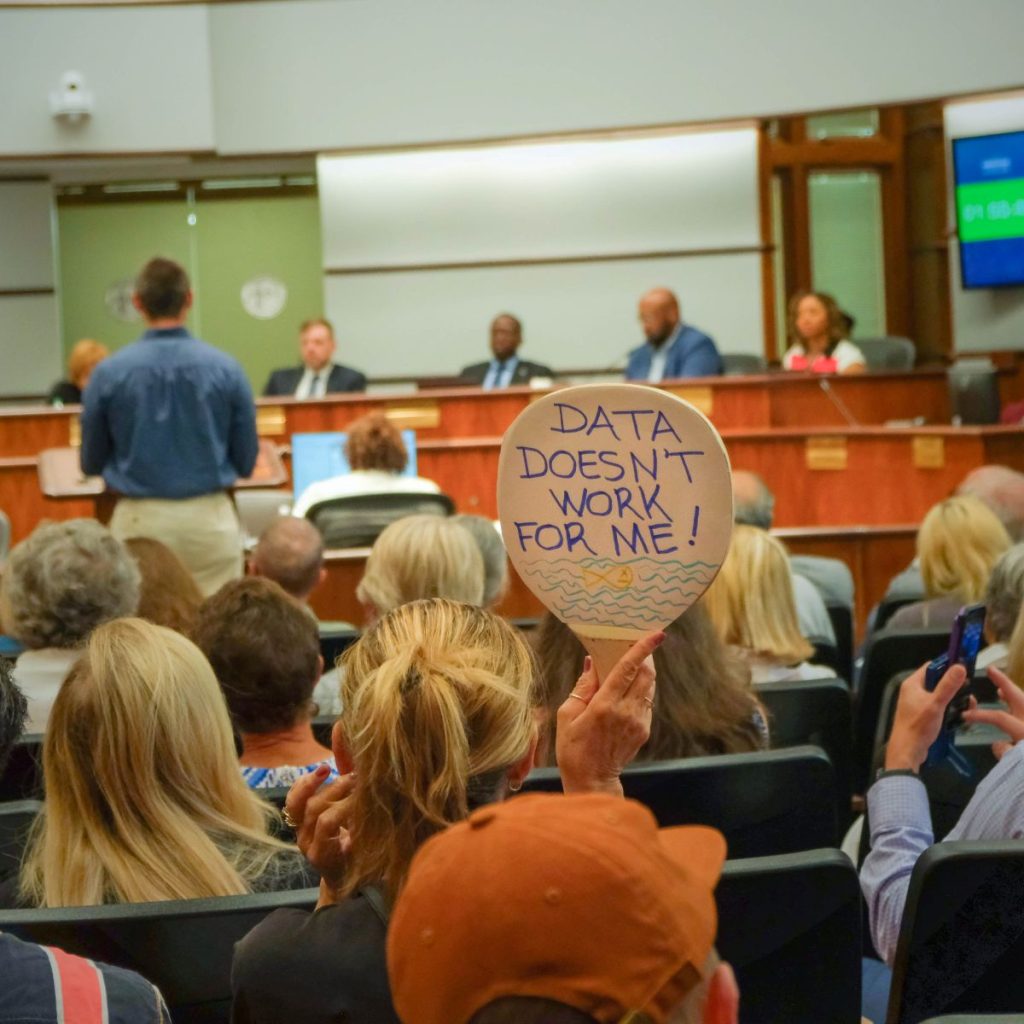
Roughly 300 people crowded City Hall on Tuesday for a contentious hearing as the Birmingham City Council debated and approved new regulations on data centers.
While city officials touted the new data center regulations as among the strongest in the Southeast and the nation, many in the crowd said the new framework still leaves too much uncertainty and too little public oversight.
The changes in the city’s zoning code were designed to put guard rails on future data center developments, zoning staff told the council. Of particular concern are the largest of those projects, called hyperscale data centers.
The new rules set out 20 conditions for hyperscale data centers, with key provisions including a minimum lot size of 5 acres, 1,000-foot setbacks from transit stations, and stricter water use, power generation and noise control requirements.
After months of work, city officials said they got it right this time.
“We have looked at all of these major concerns and created an ordinance that we genuinely believe produces one that is unmatched in the Southeast and stands among the nation’s strongest ordinances regulating data centers in the country,” said Hunter Garrison, deputy director of the Office of Resilience and Sustainability.
While several speakers during the public hearing acknowledged that the council had strengthened certain protections on data centers, none of the approximately 60 speakers supported adopting the ordinance. They argued that it removed provisions that could have allowed public debate during the permitting process and included few clear quantitative standards for sound levels, water use, or heat and emissions.
The public hearing portion of the City Council meeting began at about 11 a.m., by which time the council chamber and a makeshift holding room in the basement cafeteria had reached capacity, with a combined 200 or so people.
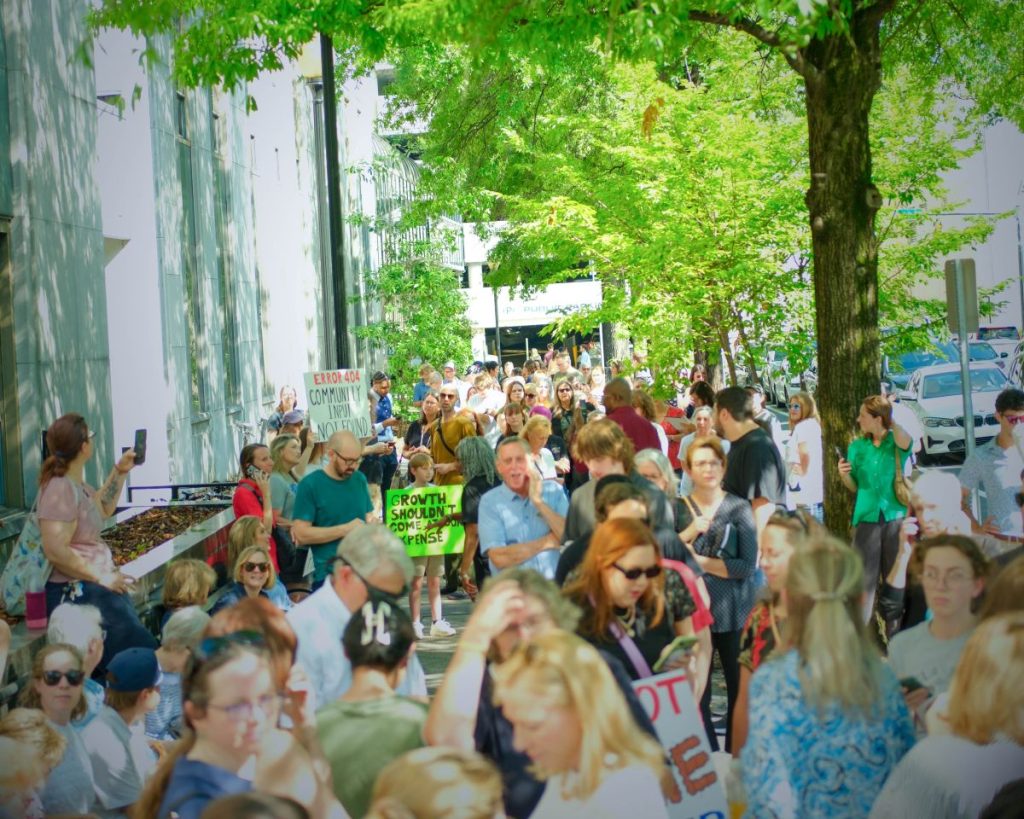
About 100 people remained outside in the heat well into the afternoon, waiting to offer their testimony.
“So many people who have to work for a living — myself included — took off today to be here to participate in democracy,” Jonathan Landham, a District 3 resident, reflected on the public hearing process, “it’s a beautiful thing, but it doesn’t need to end here.”
Some of the residents, business owners, teachers and physicians who spoke said they feared the new regulations would give them less of a voice in future data center regulations rather than more.
A key revision from draft rules reviewed in April was the removal of a special exception process for hyperscale data centers, which could have provided public hearings for zoning changes and variances. The change was a blow to advocates who urged it be kept in.
“Why I’m able to stand here matters as much as what I have to say,” said David Butler. “Right now, this council still holds public hearings on data centers; the ordinance in front of you would take that away.”

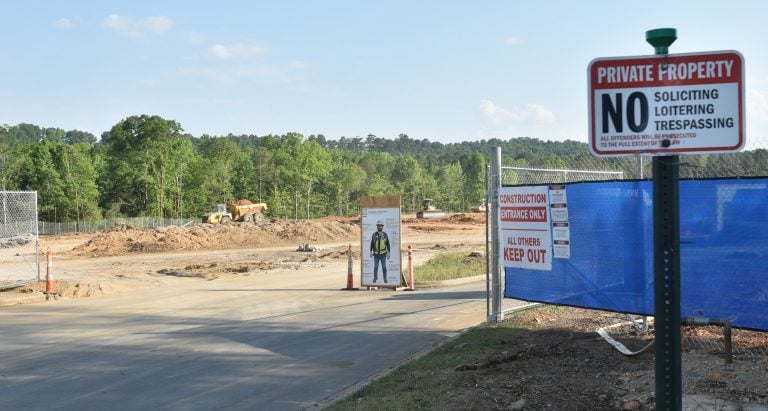
Butler and Oxmoor Neighborhood President Madelyn Greene are suing the city alongside Nebius Group as part of a class action lawsuit over the proposed BHM01 data center project in the Oxmoor Valley.
Despite Nebius not being subject to the new data regulations, since it is a project already in progress, it nonetheless served as the driver for the council’s decision to pass the ordinance Tuesday.
“If there’s an entity that’s currently permitted, that they could apply for an expansion to their existing permit, the moratorium does not apply to them,” said Councilor Josh Vasa. “The concern there is if we do not act today, there is room for growth from those entities that are currently permitted.”
Councilor Hunter Williams similarly emphasized the urgency with respect to BHM01. “I want folks to understand, should we delay a vote today, then the project that everyone has managed to bring up today — even though we’re talking about a specific ordinance — will have free rein to do whatever they want.”
The ordinance passed on a 6-3 vote, with Council President Wardine Alexander and Councilors Darrell O’Quinn and Sonja Smith opposed. According to Rick Journey, the mayor’s director of communications, June 20 is the tentative effective date for the new regulations. The ordinance must be signed and proper legal notice issued before it becomes legally binding.
Read more about Nebius’ BHM01 project, particularly its impact on the Greater Birmingham Humane Society, in WBHM’s report, produced in collaboration with BirminghamWatch.
Conditions Set for Data Centers
The ordinance maintains roughly the same 19 conditions for data center applications as the draft considered in April, with one additional requirement. These provisions include strong protections that restrict certain activities and mandate some disclosures from developers.
If applications comply with all 20 conditions, no special exception processes and public hearing are required.
Diesel and gas power generation may be used only in emergencies and are strictly prohibited for routine operations. Onsite power generation is banned except for solar energy and fuel cells; however, energy stored in onsite batteries via the grid is permitted. Hyperscale data centers are also barred from discharging stormwater directly into the municipal water system.
To limit water consumption, the ordinance requires closed-loop cooling systems rather than evaporative systems, which can consume millions of gallons of water per day. It also regulates how cooling water is flushed to ensure the removal of contaminants prior to discharge.
The minimum property size for hyperscale data centers is set at 5 acres. The required distance between hyperscale facilities and residential properties under the new regulations is 500 feet, although community advocates had asked that the distance be set at 1,000 feet. Written notification must be given to property owners within 500 feet of any new or expanding hyperscale data center, under the rules.
Noise mitigation measures — such as screening, landscape buffers, and pre- and post-construction noise studies — are required. However, critics questioned the enforceability of these provisions and whether a 500-foot buffer is large enough to screen surrounding neighbors from the data center operations.
Community concerns voiced during the hearing focused on transparency and public participation, the need for more specific technical standards and stronger measures to ensure accountability of the developers. Speakers contended that the process as set out in the new rules is too reliant on executive discretion and argued that technical experts and the public should have a greater role in enacting future regulations.
“This is what democracy looks like, and it looks pretty good to me,” said Ryan Anderson, staff attorney with the Southern Environmental Law Center. “We deserve to have a voice in data center development in our city, and we deserve to have a seat at the same table the big tech does, because these decisions influence the places where we live, work, and play.”