Virginia Martin, Author at BirminghamWatch - Page 432 of 480

Virginia Martin

Birmingham Mayor Woodfin Throws Support Behind New Stadium and BJCC Renovations

Jan. 31, 2018 — Birmingham Mayor Randall Woodfin announced his support for an expansion and upgrade to the BJCC arena Wednesday, saying revenue generated by the renovated stadium would go toward his administration’s priority of neighborhood revitalization. The upgrades would include renovations to the Legacy Arena and outside piazza, as well as the construction of a $174 million new open-air stadium, though design specifics remain undetermined. Read more.

Almost $50 Million Spent in Alabama’s U.S. Special Senate Election

Candidates and independent committees raised more than $49 million last year for Alabama’s U.S. Senate special election, won by Democrat Doug Jones. Financial reports posted this week by the Federal Election Commission show Jones with $22.05 million in contributions to his campaign during 2017, compared to $6.15 million for Republican Roy Moore. Those reports include money raised by Jones for the Democratic primary in August and the general election on Dec. 5, and by Moore for the Republican primary, GOP runoff and general election. In addition, independent committees, known as Super PACs, reported spending $2.37 million in support of Jones and $1.24 million in opposition to him. Super PACs spent $158,464 in support of Moore and $5.19 million in efforts to defeat him. Read more.

Rep. Patricia Todd Won’t Run for Re-Election

Alabama State Rep. Patricia Todd, D-Birmingham, has announced that she will not seek re-election. In a press release posted to her Facebook page, Todd cited the “financial burden” of holding public office as the reason for her decision. Read more.

Jefferson County Proposes to Establish a Health Care Authority Over Indigent Care

Jan. 25, 2018 – The Jefferson County Commission today authorized the county manager to begin discussions with the University of Alabama at Birmingham about establishing a health care authority to operate Cooper Green Mercy Health Services. The move came in response to a consultant’s report that recommended building a new building for multispecialty outpatient service clinics, selling the current Cooper Green building and entering a partnership with a healthcare authority to make more decisions about how indigent care is handled in the county. “The challenges are we have an old building and we have an operating model that is still essentially a remnant of an in-patient facility,” said Tony Fiori, managing director of Manatt, Phelps and Phillips. Read more and watch video of Fiori's briefing.

Alabama Failing Schools List Includes 22 Metro Schools

A list of 75 “failing” schools in Alabama includes 22 schools in the Birmingham metro area – 14 Birmingham city schools, two in the Jefferson County school system, and two each in Bessemer, Fairfield and Midfield. Based on 2017 test results in math and reading on the ACT Aspire standardized tests, failing schools are defined as those with students scoring in the lowest 6 percent of state schools. The failing designation and definition is defined by the Alabama Accountability Act of 2013 that was modified in 2015 to exclude schools that serve special populations of students with disabilities. The Alabama State Department of Education posted the list of failing schools, 75 out of Alabama’s 1,325 public schools, online Jan. 24, Read more. See the list of Alabama schools on the 2018 Alabama Accountability Act failing schools list.

Jefferson County Attacking Opioid Crisis With a Multi-Prong Strategy

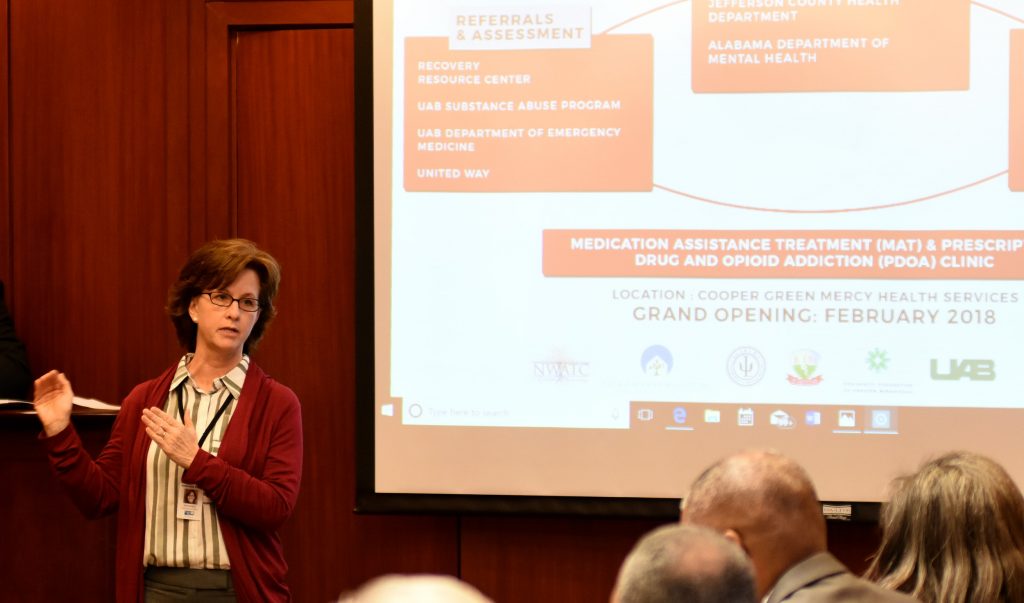
Jan. 23, 2018 – Jefferson County Commission President Jimmie Stephens called opioids the biggest crisis facing Jefferson County and said it is “a pandemic that affects everyone’s lives.” Stephens’ comments came after officials from Cooper Green Mercy Health Services and several other health agencies presented Jefferson County’s response to the national opioid epidemic during the commission’s committee meeting Tuesday. The response laid out the county’s use of a three-year, $3.9 million grant from the Substance Abuse and Mental Health Administration. Read more.

Council Moves Money From Legion Field Account to Lobby For Tax Increase to Fund Tourism and Economic Development

Jan. 23, 2018 — The Birmingham City Council voted Tuesday to reallocate $100,000 that had been earmarked for improving Legion Field to instead lobby in Montgomery for legislation designed to generate millions a year for the city. Though the specifics of the legislation were not given during Tuesday’s council meeting, Councilor William Parker, chair of the parks and recreation committee, said after the meeting that one bill would be a proposed increase to the city’s automobile rental tax. Parker said the change could secure “millions of dollars for funding for tourism and entertainment and also for economic development opportunities … on an annual basis.” https://birminghamwatch.org/council-moves-money-legion-field-account-lobby-tax-increase-fund-tourism-economic-development/

Update: Federal Funding for Children’s Insurance Program Approved in Budget Bill

Funding for the Children’s Health Insurance Program was extended for six years in the compromise budget bill passed by Congress and signed by the president Monday. Alabama and many other states had been particularly concerned about funding for the program, which was in danger of running out next month. BirminghamWatch focused on the insurance program, known in Alabama as All Kids, in the first of a planned series exploring the connections between Alabama and Washington. Read the story about the effect the federal funding has in the state: What Happens If CHIP Goes Away? Congress’ Failure to Fund Popular Health Program for Kids Could Leave Thousands in Alabama Uninsured

New Tariff on Solar Panels May Give Companies Second Thoughts About Doing Business in Alabama

President Trump imposed a stiff tariff on cheap solar cells and panels imported from China and other countries, a move industry experts said may decimate the growth of solar energy in Alabama and stunt it elsewhere in the country. The tariff starts at 30 percent for the first year. “That level would squash Alabama business for us and similar businesses that operate in Alabama to provide turnkey solar systems to residential and small commercial customers,” said Larry Bradford, of north Alabama’s Southern Solar Systems. About $5.6 billion in projects in just four Sunbelt states – Georgia, Florida and the Carolinas – could be jeopardized by a tariff, according to E&E News, which follows energy and environmental matters. The tariff could have been worse, though. It drops by 5 percent each of the four succeeding years. It also exempts a substantial portion of initial imports each year. Alabama is particularly vulnerable to the added cost of a tariff, experts in the field say, because policies of investor-owned utility Alabama Power Co. already limit solar energy penetration in a variety of ways that make solar installations more expensive here. Read more.