
Donate today to help Birmingham stay informed.
Birmingham’s regional water works board approved agreements with seven engineering firms its new CEO recommended on Friday. Some companies that previously provided engineering services to the utility were conspicuously absent from the list.
The board also selected a financial adviser and settled a public records lawsuit with two former board members regarding access to legal invoices.
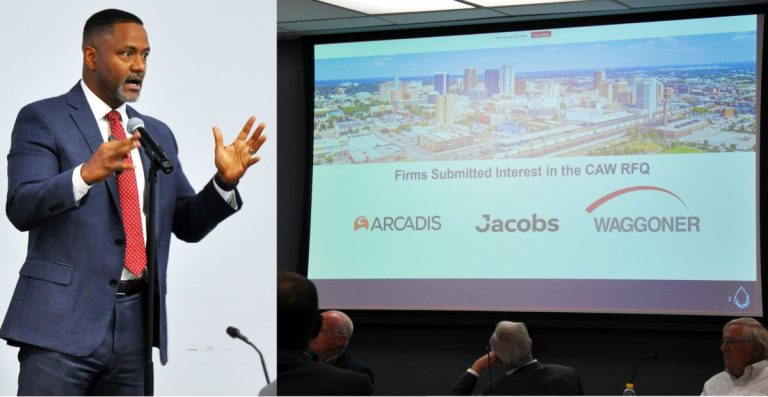
Agreements with the seven engineering firms are master service agreements with basic terms and conditions and would pre-qualify them to perform work when needed, said Jeffrey Thompson, chief executive of Central Alabama Water.
“There’s no work that’s associated with any of these,” Thompson said. “The idea is that we have a pool of different firms that, in the future, we can work with.”
The pool could include an unlimited number of companies and could be expanded any time, he continued.
The board’s new consulting engineer, Jacobs Engineering, also would have to qualify the engineering firms to do particular types of work, said Shan Paden, an external attorney for CAW.
Absent from the list was Arcadis North America, which Jacobs replaced in December as CAW’s consulting engineer and which has contracts for other CAW engineering work — including a project the utility halted this month to stabilize a high-hazard dam.
When asked if CAW was currently working with Arcadis or would continue to, board Vice Chairman Phillip Wiedmeyer said: “There’s a transition in place on that. They’re still involved. I don’t know exactly to what extent, but they haven’t closed up shop and walked away.”
To receive additional contracts, Arcadis would have to be on CAW’s approved-engineers list, in accordance with a state law that went into effect last year, he said.
The law states the CEO must recommend engineering contracts to the board.
After board member Jarvis Patton Sr. suggested tabling the decision on the engineering firms until the next meeting, so more companies could be included, Thompson said there was value in having the contractual vehicles available to the utility immediately.
Patton responded that he was hearing two different things.
“I’m hearing, they’re going to be put in this pool that we can decide upon at some future point in time if we need it,” he said. “Then I’m hearing we need them right away.”
Board member Sheila Tyson asked Thompson how many of the seven firms were minority owned.
“These firms are selected based on qualifications,” Thompson replied.
Tyson asked why Thompson didn’t look at engineering firms that have been doing work for CAW and include them on the list. She accused the board of disregarding the 92% of rate payers who live in Birmingham and Jefferson County.
“It’s disrespectful to the 92% of people that pay the salary of everybody on this board, along with everybody in this company and all the engineering companies that come through here,” Tyson said. “You don’t want to hear their opinion or pick from their peers and people that’s qualified to do the work, that have applied for these jobs with Birmingham water before.
“But you would pick somebody that that y’all privately know. You can’t tell me you haven’t discussed none of these companies with anybody on this board.” Board Chairman Tommy Hudson responded that he had not discussed the firms.
Tyson and Patton are the only two of seven board members who were appointed by Birmingham city officials and who are not white. They often vote in opposition to the other five board members.
Birmingham is a majority Black city, and 49% of Jefferson County residents are Black, Hispanic or Latino, according to the U.S. Census Bureau.
After the meeting, Tyson said none of the seven engineering firms the board approved are minority owned and a significant number of engineering firms CAW has utilized previously are. She said she has identified 16 firms that have done work with the utility in the past and were not on Thompson’s list, including A.G. Gaston Construction, founded by businessman Arthur George Gaston, who played a significant role in the Civil Rights Movement in Birmingham.
Ensuring the board contracted with some minority-owned firms was part of a policy the board rescinded in December, Tyson said. The historically underutilized business policy encouraged companies owned by women, minorities and other disadvantaged groups to bid on contracts with the organization. That policy was adopted by a previous board, when a majority of members were selected by Birmingham officials.
A state law restructured the board in May, giving majority representation to suburban areas. It changed many rules for the utility as well and required the hiring of a CEO.
When the board canceled the HUD policy, Thompson said the program “created a lot of paperwork for potential applicants to come in and do work for Central Alabama Water. We felt that it was an onerous burden on applicants to have to fill it all out, and we thought that limited competition.”
The board also cancelled contracts last year with a nonprofit that assisted minority and disadvantaged firms in bidding on water works contracts.
Financial Adviser Approved
The decision to hire Porter White & Company as financial adviser came after the board tabled the choice at its last meeting, pending a more thorough search and requests for additional proposals.
Thompson said CAW had obtained one additional proposal, from PFM Advisors, bringing the total to three.
Wiedmeyer, who suggested tabling the move before, asked Thompson on Friday to consider a co-adviser setup in which a national firm would join Porter White & Company, a Birmingham investment bank, in advising CAW.
“I do have some concerns that perhaps a financial adviser with a more national presence, reputation, and who has the ears of the financial market and credibility with them might be helpful, given our financial situation,” Wiedmeyer said.
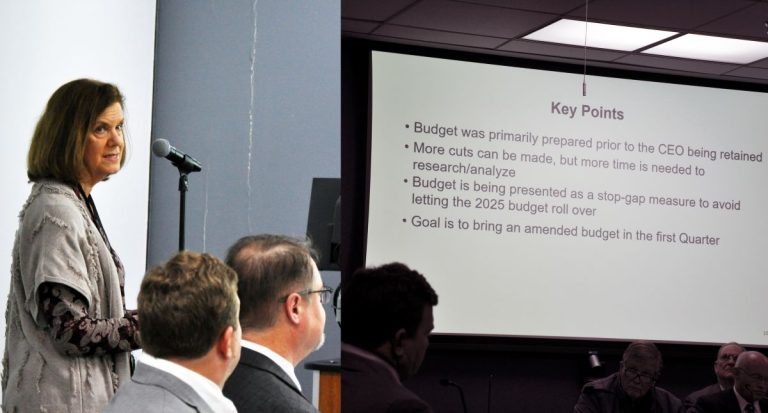
Managers struggled to create a 2026 budget that adequately funds operations and capital projects without raising rates, and Thompson has pledged to present a revised budget with further cuts in the first quarter of the year.
Wiedmeyer said last week the board would need to act on the revised budget before making decisions about the Lake Purdy Dam project or other projects.
The board risks a downgrade in its credit rating if its cash reserves drop below 150 days of operating expenses, which could happen under the current budget. Projections shared by Carol Phillips of Warren Averrett during a December meeting showed CAW’s reserves could drop to $24 million, equating to 62 days of operating expenses, after a $62 million debt payment were made.
Lawsuit by Former Directors Settled
After returning from an executive session that lasted approximately 45 minutes, the board voted to settle a lawsuit with former directors George Munchus and Lucien Blankenship for $77,500.
Filed in 2023, the lawsuit alleged the Birmingham Water Works Board — now CAW — violated Alabama’s public records law by refusing to provide complete, unredacted copies of monthly invoices from law firms doing work for the board. Because they were asked to approve the legal expenses, Munchus and Blankenship claimed the restricted access prevented them from fulfilling their fiduciary responsibility to oversee public funds.
The board’s policy is to allow directors to view detailed invoices at CAW or legal offices. They are not allowed to make copies. Invoices that are not “detailed” provide only the number of hours attorneys worked and their pay rate.
“The board will continue the same policies as in the past,” said CAW external attorney Reginald McDaniel when asked if the settlement would prompt changes.
Detailed invoices are not accessible to the press or public, Paden said. “And the reason we don’t want the detail in there is there are a lot of matters in there that are attorney-client privilege,” Paden said. “If we let you see them, then they would be available to everyone.”