
Donate today to help Birmingham stay informed.
Keisha Brown brought a bag of soot she had collected from her porch to the public hearing to show health officials what she believes causes her chronic asthma.
Barbara Jackson told of her father spitting up black dust for years before he died of cancer. Jimmy Smith said his daughter has lost body parts, and babies in his community are sick with diseases.
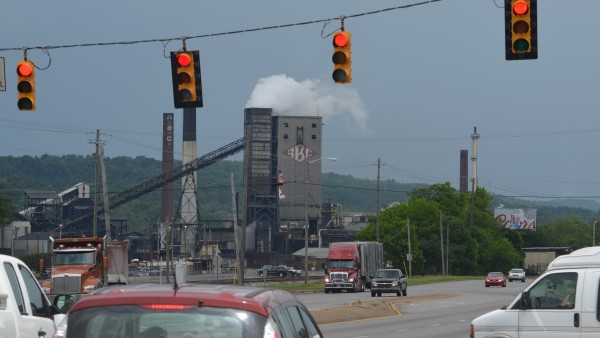
Brown, Jackson and Smith were among eight residents and advocates who spoke Feb. 24 at a hearing on whether the Jefferson County Department of Health should renew an operating permit for ABC Coke, a facility just north of Birmingham that heats coal to create coke, a fuel used in steelmaking. According to the draft permit, ABC Coke is a major source of hazardous air pollution regulated by the U.S. Environmental Protection Agency.
“We can buy bottled water, but we can’t buy a bottle of air,” said resident Anna Alldredge, addressing the two health department representatives overseeing the hearing. “Y’all need to quit permitting the people who are spewing out filth. Many people here have told you about the health effects, and as a health department, you know about the health effects of people that have been forced to suck this down all these years. I urge you to make it stop.”
Operating Under Expired Permit
Owned by Drummond Company and located in Tarrant since 1918, ABC Coke is the largest producer of foundry coke in the United States, according to the Southern Environmental Law Center.
ABC Coke is one of the industries surrounding the 35th Street Superfund Site, which was designated by the EPA for cleanup because of massive amounts of pollution over the years that presented dangers to human health. It also was at the center of a trial in which a former Drummond executive, a lawyer and a state legislator were convicted in connection with a bribery scheme to stop expansion of that Superfund site.
The facility’s five-year operating permit issued under Title V of the Clean Air Act expired in April 2024, but because ABC Coke applied for renewal six months before the permit expired, it has continued to operate legally, said Jason Howanitz, principal air pollution control engineer for the health department.
The department delayed formulating a draft permit until January because it was waiting for clarity on changing federal coke oven regulations under a new presidential administration, Howanitz said.
“We feel like we have a better understanding of what we had to put in the permit versus before, when we really didn’t know,” Howanitz said. “The worst thing you do is put it in there, and everybody thinks it’s going to be there, then you have to pull it out. That’s misleading.”
Jackson, a grassroots organizer for GASP, the Greater-Birmingham Alliance to Stop Pollution, spoke at the hearing as a resident and daughter of a man who worked at ABC Coke for 18 years. She said she thinks other motives were involved.
“There were new coke oven requirements, but they purposely held back on this permit until the Trump administration got in … . They knew this new administration wasn’t going to make them do it,” she said.
In 2024, under the Biden administration, the EPA issued new monitoring requirements and limits on coke oven emissions of some hazardous air pollutants — chemical compounds known or suspected to cause cancer, birth defects or other serious health effects or environmental damage. But in July 2025, the EPA under the Trump administration announced it was reconsidering some of the new limits and monitoring provisions. And in November, Trump granted coke oven operators a two-year exemption from the new and revised requirements. That would give ABC Coke until July 2027 to comply. The compliance dates for new requirements are included in the draft permit.
In a statement of basis for ABC Coke’s draft permit, health department officials wrote that in addition to making changes related to the flux in federal regulations, they removed an emergency provision to be consistent with changes in the law and incorporated updates to general conditions made in other Title V permits the department has issued.
Environmental, Community Groups Respond

Critics of the draft permit contend it incorrectly excludes some boilers in the facility from new air pollution and work practice standards and fails to make some requirements enforceable. GASP, the Southern Environmental Law Center, the Environmental Integrity Project and the Environmental and Climate Justice Committee of the Alabama State Conference of the NAACP submitted those comments to the health department as part of their opposition.
Speaking at the hearing, Julianne Tharp, the field and advocacy fellow for GASP, said the air pollutants ABC Coke emits negatively impact respiratory and cardiovascular health, increase rates of asthma, premature death and certain cancers, and can cause central nervous system, reproductive and developmental harms.
“The likelihood of these pollutants affecting the communities around ABC Coke is enough of a reason to request the health department do their due diligence to ensure the safety and well-being of the people they serve,” Tharp said.
The groups’ written comments and speakers at the hearing also raised concerns about ABC Coke’s past violations of environmental regulations.
The draft permit itself summarizes three violations and two warning letters it has issued to ABC Coke since May 2021. The facility has a history of noncompliance with its air permit and applicable local, state and federal law, the environmental groups stated in their written comments. It also entered into a federal consent decree in 2021 requiring it to monitor benzene leaks because of its history of violations.
Tharp said GASP is asking the health department to adjust and improve monitoring requirements and clearly identify for ABC Coke and the public which emission limits — state or federal — apply to the facility. In the past, the more stringent requirements would take precedence. But a bill Alabama Gov. Kay Ivey signed Feb. 19 could make this point moot in instances where state rules are stronger. The new law prohibits Alabama from having stricter environmental regulations than the federal government.
Health Claims
Speaker after speaker at the hearing told of deaths and illnesses from causes consistent with exposure to the toxic chemicals like ABC Coke and other past and current industrial facilities in the north Birmingham area emit.
“This is a very sad and unacceptable way to live in America,” Brown said. “It is like living in a prison in a third-world country. But yet, there are foundations for animals … who is protecting us?”
Howanitz, with the health department, said the problem with air pollution data is everybody wants to apply their own numbers to determine what’s safe.
“We don’t do that,” he said. “We can only use EPA’s number because that’s what our regulations were set to.”
He said testing for cancer-causing air pollution in Tarrant and north Birmingham in 2009 showed levels so low that there was no need to do further monitoring. And when EPA was developing its most recent coke plant regulations in 2021 or 2022, testing at the facility site was well below EPA limits, he said.
“If you can monitor on the facility’s property and be within acceptable range, it wouldn’t be any higher off site of the property,” Howanitz said.
EPA tasked the facility with gathering the data for that monitoring itself, he continued, “because you have to have somebody on the facility to collect. You can’t just have people running around and getting run over by equipment and everything else.”
Howanitz said the number of industrial plants in the north Birmingham area has declined during the past two decades, so air pollution should be trending downward.
Not Asking for Denial

Jackson said she doesn’t want the health department to deny ABC Coke’s permit request.
“I don’t want them out of business,” she said, because the plant provides well-paying jobs. “These guys got to work. These guys got families to feed. But I also worry about the safety of the guys that work there.”
Not only did her father die of cancer after working at ABC Coke, so did all of his friends who worked there, Jackson said.
Jackson said she wants all applicable regulations to be incorporated into the permit, and she wants the health department to thoroughly investigate community complaints, something she said it hasn’t done in the past.
Howanitz said the point of the public hearing and comment process is to gather information that could lead to alteration of a permit rather than its denial. The health department can’t refuse a facility a permit because of previous violations, he said, so long as those violations have been addressed.
“I don’t get to just say, ‘No, you’re not getting a permit because you had a noncompliance in the past,’” he said.
ABC Coke is currently in compliance, Howanitz said.
However, the final decision on granting the permit will be up to the department’s health officer, he said. “I would anticipate the permit would be issued, but it’s not final until its final,” he continued.
The public hearing was held on the last day of a 45-day public comment period. Howanitz said the department will review and respond to the comments and possibly modify the permit based on them before making a judgment. The process of reviewing and replying to comments typically takes less than a month, he said.
Jackson isn’t optimistic about the direction of air pollution levels in the Magic City.
With the Trump administration’s rollback of environmental regulations and the state of Alabama apparently following suit, she predicts Birmingham’s appearance will again reflect its industrial roots, with smog-filled air and soot-stained buildings.
“It’s probably going to be looking like Birmingham in the 1970s because nobody’s going to be doing what they’re supposed to,” she said.