
Donate today to help Birmingham stay informed.
The board over Central Alabama Water voted Monday to enter into two loan agreements to finance lead and unknown line replacement in the distribution system.
Budget constraints have slowed plans to replace aging pipelines and have slowed federally mandated lead line replacement.
This follows the new 2024 EPA lead and copper final rule, requiring water utilities across the U.S. to take inventory of known and unknown lines and replace them if lead or copper concentrations exceed action levels. If the action level for lead is exceeded, the utility is required to inform the public and make necessary steps to replace those lines.
S&P recently downgraded CAW’s bond rating from an AA to AA-, placing it on a negative credit watch, one of the principal reasons being its aging pipelines.
The agreement is between CAW, the Alabama Department of Environmental Management and the Alabama Drinking Water Finance Authority.
The authority is administering the loans through the State’s Drinking Water State Revolving Fund, a low-interest loan program intended to fund infrastructure improvement projects in the state.
The loan proceeds may be used only for replacing corroded copper and lead lines.
CAW will receive the two loans totaling $56 million.
The first loan is CAW’s $45,686,563 Subordinated Water Revenue Bond. The authority has set the principal forgiveness portion to 30%, meaning CAW will not be obligated to pay $13,771,563 of that total. The effective interest rate of the loan, including the administrative fee, is 1.99%.
The second loan is CAW’s $10,725,000 Subordinated Water Revenue Bond, with no principal forgiveness and an effective interest rate of 2.20%.
Both loans are dated April 1, 2026, and will mature on Feb. 15, 2049, callable after 10 years with no repayment penalty.
The authority will hire a trustee to hold funds, submit reimbursement draws and pay out. It also will obtain waivers and letters from property owners allowing the work as a way to avoid violating state provisions against working on private property.
Frank Long, attorney at Balch & Bingham, clarified that the loans will not be tax exempt, and interest will accrue with the trustee until reimbursement requests are made.
Johnathan Wilson, CAW chief engineering officer, said plans for replacing service lines will be part of a future bidding process and will not be done in house.
Minority Hiring Minimums Questioned
CAW board member Jarvis Patton Sr. raised concerns about the low objective requirement for minority- and female-owned business participation percentages, which are 2.6% and 3%, respectively. The percentages, the standard loan conditions agreements set by ADEM, are objectives that can be exceeded based on whom CAW chooses during its competitive bidding process.
Patton requested amendments or clarifications be made to the loan agreements, suggesting that the state provide a document explaining its percentages.
“I want both of them and understand how important the project is,” Patton remarked, “but with respect to a reasonable amount of minority, female, disadvantage business participation, I think it’s totally, grossly unfair.”
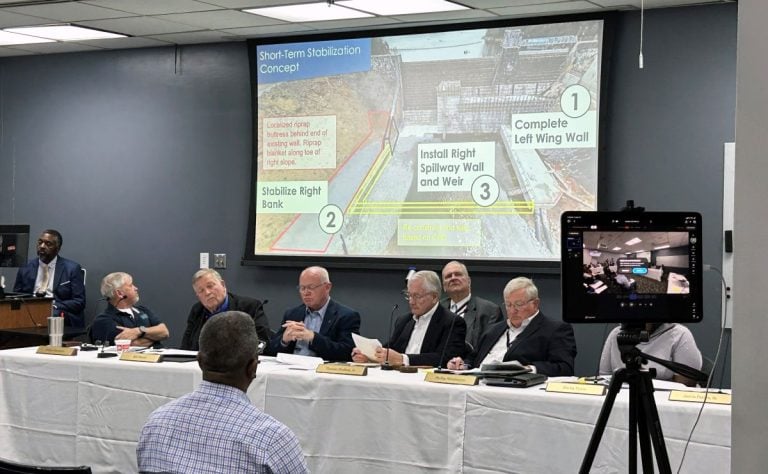
The loans passed 5-2, with board members Sheila Tyson and Patton voting against, and Chairman Tommy Hudson, Vice Chairman Phillip Wiedmeyer, Jeffrey Brumlow, Bill Morris and David Standridge voting in favor.