
Donate today to help Birmingham stay informed.
A global bond-rating agency downgraded the rating of Alabama’s largest water utility Wednesday and placed it on a negative credit watch, signaling there’s at least a 50% chance the agency could lower the rating again in the next 90 days.
A lower bond rating means higher interest rates when the utility borrows money, which could translate into higher customer bills.
“The rating change reflects the system’s weakening liquidity position and aging assets, coupled with a substantial reorganization of management,” S&P Global Ratings said in announcing it lowered Central Alabama Water’s long-term rating from AA to AA-.
S&P has requested documents, data and information regarding CAW’s financial and capital planning, and if it doesn’t receive them within 30 days, it will likely withdraw the bond rating altogether, according to the announcement. That would be the equivalent of an individual having no credit score.
CAW has been grappling with financial issues and plans to revise its budget soon to cut spending more. The utility’s cash reserves are predicted to hit an extreme low point in August, leaving it with only 62 days of cash on hand, according to its accountant. The utility hasn’t been able to keep up with repairs needed to its aging infrastructure; it loses approximately 40% of the water it treats through leaks because of the aging pipelines. Oversight of the utility has been changed in the past year with the restructuring of the water works board, and a new CEO hired in November, replacing the entire senior management team, putting previous managers on paid leave.

A CAW press release blamed the rating downgrade on weakened finances that “developed over the past several years” and on management and decisions made before the state law restructured the utility and its board in May of last year.
“Central Alabama Water’s predecessor organization (Birmingham Water Works) exceeded its operating expense budget for multiple years while allowing unbilled and lost water to grow to high levels,” the release states.
These were also concerns that prompted the Alabama Legislature to approve the law reorganizing the utility, the release continues.
But Larry Ward, who was a member of the water works board and chair of its finance committee from 2020 to 2025, said all three reasons S&P gave for the downgrade are directly attributable to the new board.
He said the board during his tenure provided S&P with extensive financial data and information on unbilled and lost water. If S&P had been concerned, it would have lowered the rating then, he said.
“As long as I was finance chair, we guarded that prize (AA) rating very thoughtfully, very carefully,” said Ward, who previously headed the public finance division at brokerage firm Morgan Keegan & Co. “We understood the significance of that.” The utility has held an AA S&P bond rating since 2013, according to a 2022 water works budget presentation.
Ward said the reason CAW’s aging assets matter to S&P now and didn’t before is because the utility can’t — or isn’t — doing anything about them.
“We had a plan to deal with aging assets,” he said of previous boards. “We were replacing so many miles of pipe every year. In the water business, you have to keep your infrastructure in good condition. And the longer they go without repairing these things, the more expensive it’s going to be.”
Current board members have said CAW can’t get bond-market financing for capital projects such as pipeline replacement because the city of Birmingham has filed a federal lawsuit challenging the state law that restructured the utility and its board.
While the $20.1 million set aside in the 2026 budget for main pipeline replacement projects is the same amount that was in the 2025 budget, CAW Chief Executive Jeffrey Thompson suggested in December that spending could decrease when managers present a revised 2026 budget in March.
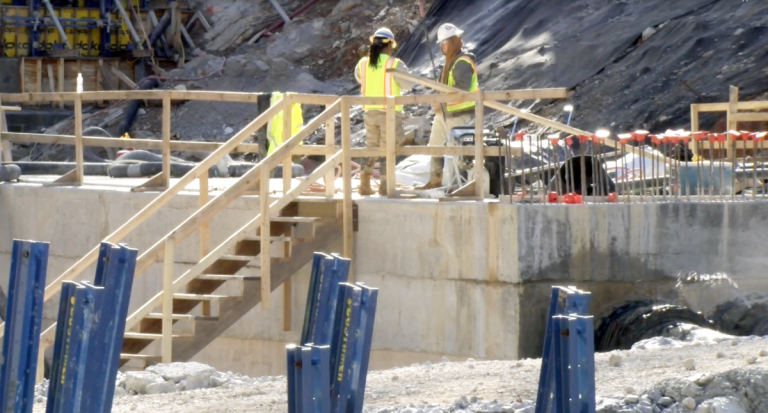
CAW has also stopped work on a project to stabilize the 116-year-old Lake Purdy Dam, which supports a reservoir that provides water for a significant portion of CAW’s customers and which engineers have said is not safe enough.
In its press release on the bond-rating downgrade, CAW pointed to that action as a sign of new managers’ fiscal responsibility.
“Since November 2025, the new management team has taken steps to improve the utility’s financial outlook including pausing the project at Lake Purdy Dam for reevaluation,” the release reads.
It goes on to say the board’s new consulting engineer is evaluating the project and will issue a report soon.
Ward said the project is imperative, and the previous board followed the advice of engineers in approving it. Delaying the work would save money only if the costs for labor, concrete and steel went down, he said.

Revised Budget on the Way
CAW managers struggled to create a 2026 budget that adequately funded operations and capital projects. That budget cut capital expenses by 25%, and CAW’s release said the revised budget is expected to include more fiscally conservative adjustments.
“We anticipate the revised budgets to provide a path forward to ensure the long-term financial stability of CAW,” Thompson said. “We have already taken steps to improve our financial position and will continue to do what is necessary to create a world-class water utility that our customers can trust.”
Reduced Labor Costs, More Staff Concerns
One way managers cut costs in the existing budget was by freezing hiring for many positions and eliminating employee raises.
CAW’s Employee Association linked the need to cut costs with the utility’s move on Feb. 9 to begin unannounced drug testing of all employees.
“This action appears to be used to reduce staffing levels through ‘attrition,’” the association’s statement said. “We are also aware of a continued decline in employee morale following the appointment of the CEO and SET (senior executive team), driven by a lack of communication, unclear promotion procedures, and the random creation of job titles.”
The association’s president said 30 employees have been terminated or placed on unpaid leave because of the drug tests, pending verification of prescription medicines.
John Matson, public relations manager for CAW, said the utility is conducting baseline drug testing in accordance with a new employee handbook instituted last week and it will carry out random testing going forward.
CAW has a public health and safety responsibility to ensure its employees are not impaired at work, he said.