
Donate today to help Birmingham stay informed.
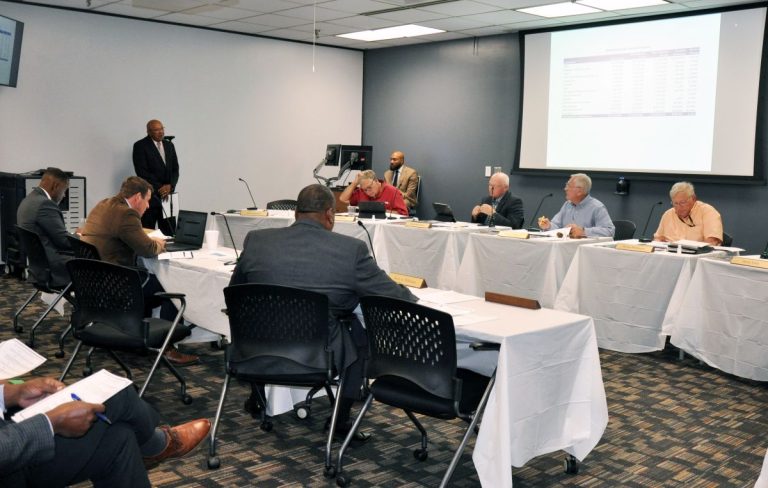
The City of Birmingham Regional Water Works board held a two-hour budget workshop on Monday that failed to produce new ideas for funding operations without raising rates or drastically cutting spending on major capital projects in 2026.
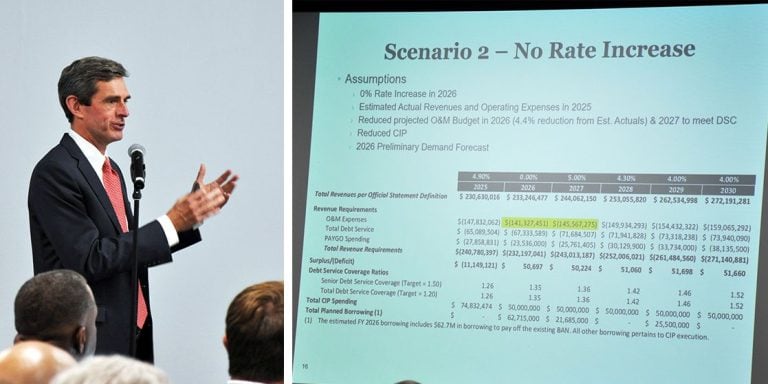
“If you don’t want to do much in your capital budget, you can do a 0% rate increase,” water works General Manager Mac Underwood told the board. “That’s something I want to make sure everybody understands. There’s no room to do AMI (automated-meter-reading infrastructure) and some other improvements I think you want to do when you consider that factor.”
Budget constraints also will slow plans for replacing aging pipelines in the system and could slow federally mandated lead line replacement. Plans to shore up the aging Lake Purdy dam also are being reconsidered as the board was told the water works has only $1 million in liability insurance for the dam.
During the workshop, Underwood continued a presentation of the preliminary operations and maintenance budget that he gave in the Oct. 6 board meeting. Despite foregoing employee raises and leaving most vacant positions unfilled, the preliminary budget for 2026 is about $450,000 more than the 2025 budget, due to projected increases in legal, billing and materials costs.
Legal fees have increased, in part because of a federal lawsuit the city of Birmingham brought over a state law, effective in May, that restructured the utility’s operations, its name and its board, giving suburban areas more representation.
Central Alabama Water, formerly Birmingham Water Works, likely can’t raise rates at the beginning of next year because of a provision in the law that requires a consulting engineer to analyze proposed rate increases. The board has not yet hired such an engineer, and annual rate increases are typically approved by Nov. 30 of the preceding year.
The lawsuit also means the utility can’t go to the bond market to finance projects, Underwood and board members have said.
Underwood noted Monday that costs to find and employ a chief executive – a new position the state law requires – and to rebrand the utility under a new name and logo also will increase the budget.
Capital Cuts Questioned
Carol Phillips with Warren Averett, an accounting firm for the water works, challenged the board to make more cuts in the operations and maintenance budget to free up funds for capital projects.
“My gut tells me that what we have done here with this presented budget is that we have not made really difficult cuts in the O and M budget that we presented, but we have made very significant cuts in the capital budget,” Phillips said. “The capital budget last year was running around $75 (million) to $80 million, and this year we’re projecting $50 (million), and that, I think, is what is projected out for a number of years.”
2025’s actual capital budget was $115.6 million, up from $84 million in 2024.
“I guess I just look at it like this: ‘How many times do I have to repair my refrigerator before I decide I just need to suck it up and buy a new refrigerator?’ Phillips continued.
Automated Meters, New Pipelines on the Line
A phased project to implement automated-meter-reading infrastructure, which had completion slated for 2028, was stopped in July due to funding issues, Underwood said. Selecting vendors for smart meters and other aspects of the system was the next step when the project was paused, and phase two — which was to involve planning for implementation — had been scheduled to begin by the end of this year.
The switch to automated meters was expected to significantly reduce the number of inaccurate and estimated bills BWW customers have complained about for years.
The preliminary 2026 budget doesn’t include any funding for the AMI project.
“At this point, we can’t fund AMI, in my opinion,” Underwood said.
Water works managers also told the board Monday that pipeline-replacement work would slow significantly in 2026 compared to recent years due to budget constraints, and that likely would lead to more leaks and repairs, raising operating costs.
Managers have reported that the system loses 40% of water to leaks and many pipelines have exceeded their life expectancies. An additional 8.5% of water in the system is unbilled because it is water the utility uses itself, water that flows through faulty meters and is siphoned by unauthorized users, and water lost due to pipeline flushing that’s required to maintain water quality, managers told the board in May.
Underwood said Monday that progress has been made in replacing 25% of “zero-consumption-account” meters that weren’t functioning, meaning customers weren’t being billed. This work will continue, he said, but replacing meters takes labor and time.

Future of Lake Purdy Dam Stabilization Uncertain, Insurance Insufficient
Another capital-improvement project — Lake Purdy Dam stabilization — is included in the $50 million preliminary 2026 budget, Underwood said. The dam is currently undergoing rehabilitation work.
The new board halted work on the project earlier this year to consider the dam’s structural integrity and ways to pay for the stabilization work. It decided in July to complete phase one of the project, which began in November 2024.
“This dam is not safe enough, right, based on national best practices for dam safety,” Patrick Flannelly, senior vice president for Arcadis North America, an engineering firm involved in the project, said in July.
Phase one is projected to end in mid-January. After that, board Vice Chairman Phillip Wiedmeyer said in July, the board would see where things stand financially and from an engineering standpoint.
In the 2025 capital budget, $22 million was earmarked for the dam project. The previous board approved a total cost of $88 million for the rehabilitation work, which was anticipated to take four years.
The new board learned during Monday’s budget workshop that it has only $1 million in liability insurance for Lake Purdy Dam.
Failure of the dam could threaten thousands of homes and risk loss of life in a 40-mile wave stream, Flannelly told the board in July.
“As you can imagine, should that happen to fail, then it should be catastrophic,” said Phillip Moultrie with Valent Group during a presentation about the water works’ property insurance. “$1 million would be pocket change. Even $20 million would be pocket change. It’s hard to fathom what kind of liability the board may face.”
Moultrie said obtaining more liability insurance for the dam while it’s undergoing rehabilitation work might be impossible, but he’s exploring markets. If such insurance could be attained, costs would be significantly higher, he said.
Loan for Lead Service Line Replacement in Jeopardy
Underwood told the board that the lead service line replacement is a capital project that must move forward because the federal government is mandating it. Under federal regulations, public water utilities must replace all lead and some galvanized service lines in their systems by 2037.
“We are having to comply with the lead service line replacement guidelines by the federal government,” Underwood said. “So we’re going to have to do more and more lead service line replacement. That’s a lot in the city of Birmingham, in the older communities.”
At its Sept. 8 meeting, the board approved applying for a $47 million federal loan to replace lead service lines. After successfully applying for that loan from the EPA’s Drinking Water State Revolving Fund, the board could apply for three others, for a total loan value of $183 million. The board’s approval of the loan application was subject to the city of Birmingham agreeing to recognize the loan if it wins the lawsuit challenging the state law that restructured the board. Attorneys told the board the city’s agreement likely would be needed for loan approval.
Birmingham Mayor Randall Woodfin posted on Facebook Monday that he’s asking for accountability before supporting the loan application.
“I want to see these repairs happen,” Woodfin’s post reads. “Replacing old pipes, improving infrastructure — that’s good for our people. But before I sign off on anything, I’m asking for some basic accountability.”
He listed three requests: don’t raise rates, include minority contractors in the work and bring legal work in-house.
The 2026 budget assumes the water works will receive at least two of the federal loans, Peiffer Brandt, president and CEO of Raftelis Financial Consultants, told the board Monday. That debt service appears in the 2026 preliminary budget, he said.
At the conclusion of the budget workshop, Underwood asked board members to let managers know what questions and concerns they have about the budget and said staff would make changes and corrections before the next budget workshop. He said multiple workshops likely would be held before the board votes on a 2026 budget.