Donate today to help Birmingham stay informed.
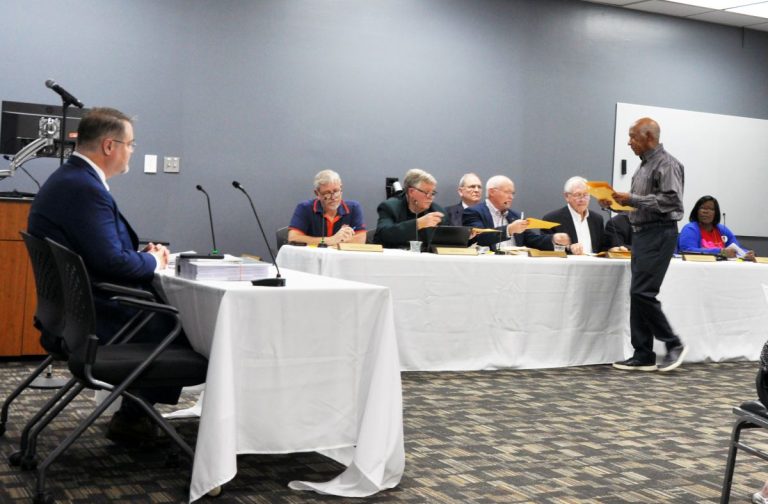
Immediately after being elected presiding officer for a meeting of a new board overseeing Alabama’s largest water utility, Tommy Hudson said he wanted to make a statement.
“I want to assure everyone that this board is in agreement with conducting ourselves in the most transparent manner,” said Hudson, whom the board later chose as its chairman.
Other board members made similar pledges in those early months after a state law effectively dissolved the previous Birmingham Water Works Board in May and required a new board that shifted majority representation from the city to the suburbs. The law also mandated a new name for the organization, and in selecting a logo to accompany that new name, the board chose a hollow water drop — to symbolize transparency.
But by November, people were calling the board’s transparency claims into question. Birmingham Mayor Randall Woodfin appeared before the board, accusing it of hypocrisy.
He said the need for more transparency and accountability from board members was an argument given for the new law. “Ever since y’all have been a board, every action you’ve taken has been the opposite of that,” Woodfin continued. “None of it has been transparent. There’s been no accountability.”
Legislators and other supporters of the legislation that restructured the board said it was needed to address long-running customer complaints about inaccurate bills and high rates. The utility hasn’t kept up with maintaining its aging infrastructure, and it currently faces a financial crisis.
But some board members complain that adequate discussion is not taking place at meetings, committees that served as a vehicle for discussion have been eliminated, and they aren’t given copies of full legal invoices they’re asked to approve. They allege they and the public are being left out of conversations. A CEO search committee did not meet in public, and the board frequently holds executive sessions that are closed to the public.
Against this backdrop and 10 months into the new board’s tenure, BirminghamWatch looked at the transparency track record of a public water utility that has been renamed, reshaped and reorganized under a state law that applies to only one organization — now known as Central Alabama Water.
Some Board Members Want More Information, Discussion
Since the seven-member board was seated, the two members appointed by Birmingham city officials have regularly asked for more discussion of — and time to consider — matters the board must decide. Often, they are overruled and voted down.
The two say other board members seem to have earlier and more extensive knowledge of agenda items than they do.
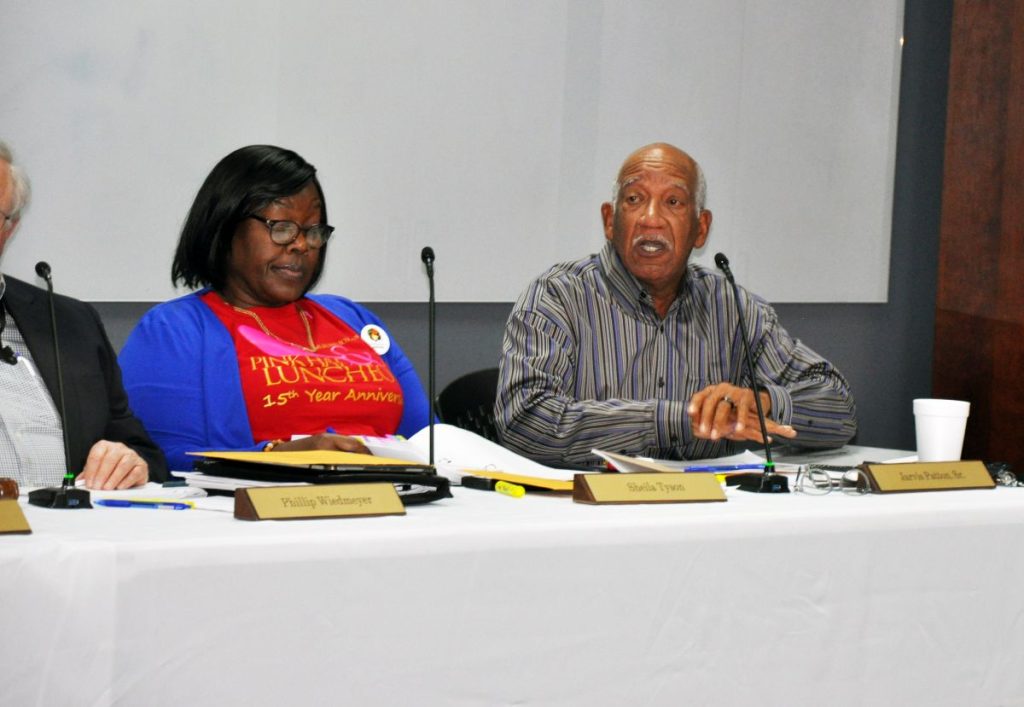
Board member Sheila Tyson, a Jefferson County commissioner whom the Birmingham City Council appointed to the water board, said the lack of interest in discussion by some board members raises red flags.
“Anytime you can come to a meeting with seven people and you don’t talk about nothing, just vote on it … You had to communicate with those people, with at least five of them,” Tyson said. “So five people are communicating, and two are being left out.”
Alabama’s Open Meetings Act generally prohibits a majority of public board members from deliberating outside of a public meeting that has been officially announced in advance.
John Matson, public relations manager for CAW, said in a written statement that all board members receive the same information prior to each board meeting.
“No decisions are made in advance of board meetings,” he wrote.
In July, the new board adopted bylaws that set limits on discussion by board members during meetings. Members must address only the board’s chairperson and only the question under debate, cannot speak for more than three minutes on any subject, except by majority vote, and can’t speak on any topic more than twice, unless the board grants unanimous consent.
Hudson strictly adhered to the current and previous bylaws’ discussion limits for a while, leading to tense meetings in which Tyson and Jarvis Patton Sr., a board member Woodfin appointed, struggled to ask questions and have them answered.
Patton said he’s usually allowed to say his piece now.
“Someone has decided … we’re going to allow him to speak, and when he gets to the point that we figure he’s said enough, we’re going to call for the order of the day,” Patton said. “Then what they do, they will vote on whatever they want to vote on, and the vote ends up being 5-2 or 4-3.”
Bill Morris, a board member Lt. Gov. Will Ainsworth appointed, said if he has questions about an item on the agenda, which is typically provided to board members and the public one or two business days before a meeting, he calls the utility’s chief executive in advance of the meeting.
“I’ll call and say, ‘Tell me what’s going on with this so I’ll know ahead of time what we’re looking at,’” Morris said. “And I think all seven of us have the opportunity if we need to call the CEO and ask him particular questions.”
Patton said that method works for him only about 50% of the time.
“Sometimes calls are returned, sometimes calls are not returned” before a meeting, he said.
“I don’t want a pattern to be developed where decisions are made by one or two people rather than a body, prior to a final item being voted on,” he said, adding that already is happening.
Many of the bylaws’ restrictions on discussion at board meetings aren’t unusual — they conform to Robert’s Rules of Order.
But current and former board members said the new board eliminated the forums where most discussion took place when it dropped the use of standing committees.
Larry Ward, a former water works board member and chair of its finance committee from 2020 to 2025, said previous boards had committees composed of a subset of members who researched and discussed topics in depth before making recommendations to the full board. The meetings of these committees, which were focused on specific topics such as finance or engineering and maintenance, were open to the public.
“We required things to go to the appropriate committee before they went to the board,” he said.
Often, board members would attend meetings of committees they weren’t part of “because they wanted to be as educated on issues as possible,” Ward said.
Current bylaws give the board’s chair authority to create committees as needed. Hudson, the chair, said standing committees haven’t been necessary.
“This is a new organization,” he said. “We’ve all known each other less than a year. We’re trying to get our arms around things. I think things are going as well as they can at this point in time, without committees.”
Morris, who is the general manager of Leeds Water Works, also said he doesn’t think standing committees have been needed.
“If something were to come up, the chairman could say, ‘Hey, let’s put a committee together and research it,’” Morris said. “But to have day-to-day standing committees, I think we’re OK without them. There may be a time when they need to have a committee. It’s not gonna hurt anything. But if we don’t need it, then I support the CEO’s leadership on that.”
Patton has brought up the lack of standing committees in multiple meetings.
Board Vice Chairman Phillip Wiedmeyer, whom Jefferson County Commission President Jimmie Stephens appointed, said standing committees would be helpful to the board and CAW as an organization.
“It allows more detailed discussions to be had, to dig deeper into the respective matters,” he said.
Board Frequently Meets Behind Closed Doors
Concerns also have been raised about the frequency of the new board’s executive sessions. While state law requires most board meetings to be public, executive sessions are legally secret, provided they conform to narrow parameters.
The new board has gone into executive sessions during 11 of its 17 regular board meetings.
“The Open Meetings Act generally says that meetings with public bodies where there’s a quorum, where they’re going to deliberate on something that they’re going to vote on, those need to be done in public,” said Evans Bailey, general counsel for the Alabama Press Association and an attorney with the firm Rushton Stakely. “It’s based in real simple, real easy notions of government transparency, which most everybody agrees is a good thing.”
Under Alabama law, executive sessions can be held only for nine specific purposes.
Twice in the past month, Hudson has proposed executive sessions for other purposes. During a Feb. 20 meeting, Patton asked to speak about board policies and procedures, and Hudson denied his request, saying the matter could be discussed in an executive session. On March 6, Hudson suggested meeting in executive session to discuss a new employee handbook.

“I don’t know that this would qualify for executive session,” one of CAW’s external attorneys, Shan Paden, replied. “I think it would just be a public meeting.”
The legal reason Paden, the attorney who oversees CAW’s executive sessions and a former Bessemer city attorney, typically gives for the board’s executive sessions is “threatened or pending litigation.”
Paden attributed the frequency of the CAW board’s executive sessions to the body having more litigation on its plate than others with which he’s familiar.
“It started out from day one, born in litigation when Birmingham filed suit against this board, challenging its legal authority,” Paden said.
Birmingham city leaders filed a federal lawsuit challenging the state law that restructured the utility and changed the makeup of the board. Other suits pertain to personnel issues and open records. Since Paden spoke last month, four other major lawsuits were filed against CAW’s board — another related to the state law and three by former managers who were placed on leave by the CEO the law required the board to hire.
During executive sessions held due to threatened, pending or imminently likely litigation, an attorney can provide board members with legal advice, Bailey said. But board members cannot discuss how to proceed.
“What shouldn’t happen is the members should not start deliberating what action to take relating to the pending or threatened litigation based on the advice of the lawyer,” Bailey said. “That’s supposed to be done in public … . The session has to be concluded, and the deliberation should be conducted in the open portion of the meeting.”
The CAW board rarely returns to an open meeting after its executive sessions.
Paden said it’s his job to prevent board members from crossing the fine line into deliberation during executive sessions.
“I’m not going to let them do that,” he said. “I don’t let them get off topic in executive session. I don’t think you should play loosey goosey with the law. It’s there for a reason.”
During a regular board meeting held Jan. 5, Patton brought up a number of topics that Hudson said would be added to an executive session that had already been scheduled, with Paden stating threatened or pending litigation as the reason. One was further details about the Lake Purdy Dam project after Patton asked about its status and CEO Jeffrey Thompson replied that the contractor had demobilized — a statement the contractor later disputed.

Lake Purdy Dam is a 116-year-old structure that supports a major water supply for CAW customers. Engineers have said the dam isn’t safe enough and its failure would threaten lives and property in a 40-mile wave stream. A four-year project to stabilize the structure is now on hold.
Patton and Tyson pushed for public discussion about why the project was suspended, but the board voted to have that conversation in private.
Wiedmeyer said at the time there was no litigation surrounding the dam project. Still, Bailey said some aspects of the project could have been discussed legally in executive session.
“You might need to talk to your lawyer in executive session to understand what the consequences are of certain decisions, or to get advice regarding certain decisions,” Bailey said.
Paden said that was his premise for including the dam project in the executive session.
“We’ve got a contract with a contractor for work on a dam,” he said. “That contract may or may not be terminated, and if it’s terminated, there could be certain legal issues that arise due to that.”
But if any discussion occurred beyond gathering legal advice, that would not have been OK, Bailey said. Talking about what to do on a public project should be done in the open, he said.
“Spending the public purse is one of the things that transparency is all about,” Bailey said. “The people should know about it, because it’s our money.”
The board did not return to an open meeting after the Jan. 5 executive session. The following day, CAW sent a formal stop-work order to the dam project contractor, Thalle Construction, according to a statement from the company.
“The timeline definitely looks not good,” Bailey said.
The board did not vote to pause or stop the dam project. It voted in July to finish the project’s first phase, which is incomplete.
Paden said the board would have to vote to terminate the contract for the project, but Thompson had the unilateral authority to pause it.
“The CEO is in charge of operations of the facility,” Paden said. “So it’s my opinion the CEO has the right to issue a stop work order. The board can’t manage and operate that project. They can authorize the project. But the day-to-day management of it has to be operated by someone, and the law says that’s the CEO.”
According to the new state law, the CEO has full authority to manage the utility’s operations, but this power is subject to the policy directives and governance decisions of the board.
Limited Information Released on CEO Search and Hiring
The way the board appointed the CEO in November raised many transparency questions.
The new state law required CAW to hire a CEO. A general manager previously headed the organization. In July, Hudson appointed himself, Wiedmeyer and board member David Standridge to a search committee to find a chief executive. Later that month, the board voted to hire Russell Reynolds Associates, a recruiting firm, to assist the committee.
According to the board’s contract with the recruiting company, the search process was to include in-person candidate interviews with the “broader board,” which Wiedmeyer said means the full board and presentations by the finalists.
Between July and November, Tyson and Patton asked during meetings for information and progress reports.
“I’m thinking, at some point in time in the very near future, we’re going to be asked to vote on a new chief executive officer,” Patton said at a meeting in October. “I don’t know who’s applied, or did they apply … . I just, I’m confused about a lot of this.”
Hudson responded that the committee would make a recommendation to the full board. He said naming candidates could jeopardize the jobs of those not chosen. Patton said he didn’t see a problem with board members knowing who the candidates are.
At a special-called board meeting Nov. 20, Hudson requested a vote on hiring Thompson, the only candidate whose resume had been presented to the full board. Over heated protests from Tyson and Patton and after multiple attempts to delay the vote failed, the board approved hiring Thompson in a 4-2-1 decision.
Wiedmeyer, a member of the search committee, voted “present,” saying he had issues with the process that led to the vote. Last month, he elaborated: “We didn’t completely do what we said we were going to do in that process. It was laid out in the agreement letter (with Russell Reynolds Associates) how the process was going to be conducted.”
Wiedmeyer said the search committee interviewed eight to 10 candidates virtually and held no other meetings. In-person candidate interviews with the full board did not happen, and candidates did not give presentations, as outlined in the agreement with the search firm, Wiedmeyer said.
No search committee meetings were announced or open to the public. Still, Matson said the search committee was “??in full compliance with the Alabama Open Meetings Act.”

When the mayor addressed the board in November, he alleged that some board members held meetings at Vestavia Country Club with the new CEO before the board voted to hire him.
Matson said no such meetings took place.
If any board members met in relation to the CEO search after the candidate field had been narrowed, that could have violated the Open Meetings Act, Bailey said.
“Once the number of candidates is reduced to three … any meetings with candidates have to be in public,” he said.
In a Facebook post, Woodfin questioned whether Thompson was involved in providing support to state legislators in relation to the legislation that restructured the board and required a CEO be hired
Matson said Thompson did not provide that support to legislators.
In a Nov. 24 meeting, Tyson presented a letter to her fellow board members requesting answers within 10 business days to questions about the CEO search, including information about any meetings and communications about the process.
She recently said she hasn’t received a response.
Continuing Limitations on Reviewing Legal Invoices
The new board has continued the old board’s policy limiting access to legal invoices, despite paying $77,500 in January to settle a public records lawsuit surrounding the policy.
Former board members George Munchus and Lucien Blankenship filed the lawsuit in 2023. It alleged the Birmingham Water Works Board — now CAW — violated Alabama’s public records law by refusing to provide complete, unredacted copies of monthly invoices from law firms doing work for the board.
Because they were asked to approve the legal expenses, Munchus and Blankenship claimed the restricted access prevented them from fulfilling their fiduciary responsibility to oversee public funds.
The board’s policy is to allow board members to view detailed invoices at CAW or legal offices. They are not allowed to make copies. Invoices that are not “detailed” provide only the number of hours attorneys worked and their pay rate.
“The board will continue the same policies as in the past,” CAW outside attorney Reginald McDaniel said in January, when asked if the settlement would prompt changes.
Detailed invoices are not accessible to the press or public, Paden said. “And the reason we don’t want the detail in there is there are a lot of matters in there that are attorney-client privilege,” Paden said. “If we let you see them, then they would be available to everyone.”
Bailey said legal invoices for public bodies are still public records, even though they are subject to attorney-client privilege. Board members, the press and public should have access to invoices that redact only privileged information, he said.
“You’re not supposed to redact stuff that’s not subject to the attorney-client privilege,” Bailey said. “So the fact that I may have talked to a client on a particular day, and that goes on a bill, that’s not privileged. But if I include on that bill what we talked about, that would be privileged.”
Regs Strictly Limit Ability for the Public to Address the Board
The policy on allowing speakers to address the board also has been criticized as another barrier to the flow of information. The policy in the new board’s bylaws is similar to one the previous board briefly imposed in April, before rescinding it due to public outcry in the lead-up to the Legislature’s passing the bill to restructure the board.
Proponents of the legislation criticized the previous board’s move to a more restrictive policy, saying it was an example of opaqueness between the board and the public that needed to be corrected.
But when the new board adopted bylaws in July, the speaker policy became more restrictive again. Under the current bylaws, those wishing to speak must submit a request in writing to the CEO. Then the CEO has to refer the request to the chair. No more than two people can speak on a given topic.
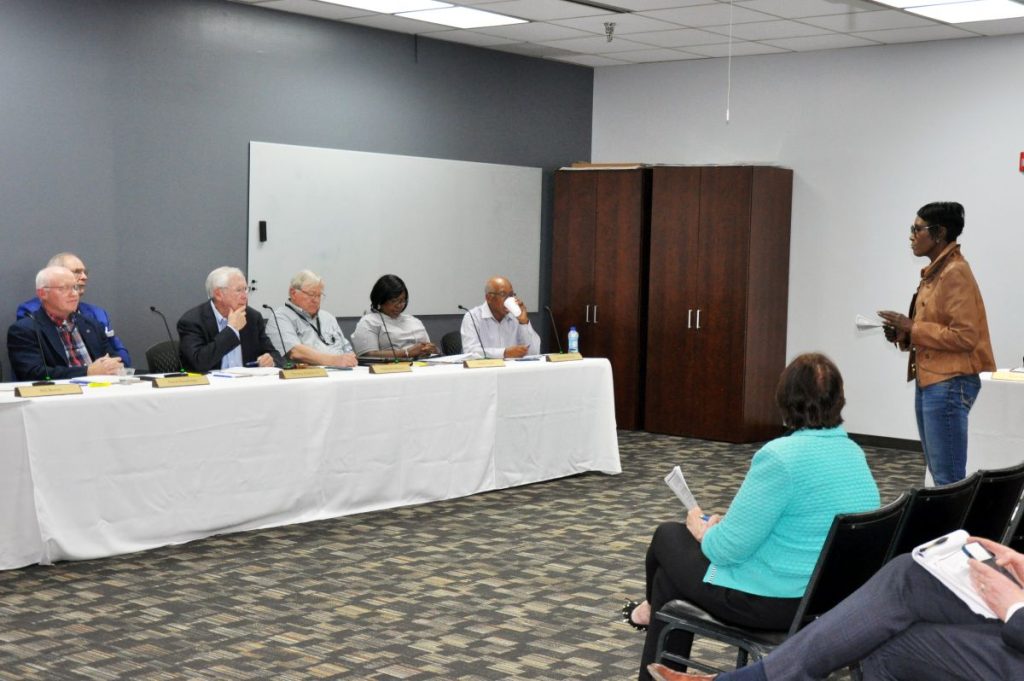
Slightly revised bylaws passed in March added more restrictions, including allowing the chair sole authority to approve or deny any individual’s request to speak.
The bylaws characterize “speaking on matters not before the board” as disruptive actions that will not be permitted.
See the new bylaws with revisions marked
Hudson, the board’s chair, said he isn’t aware of any requests to make public comments since the board approved the bylaws.
Only two public speakers — both government officials — have commented at board meetings since that time. One speaker was Woodfin. Another was state Rep. Juandalynn Givan, D-Birmingham, who addressed the board last month about employees’ claims the utility’s managers are treating them unfairly.
One issue Givan brought up was a new employee handbook the utility’s senior managers implemented last month without consulting the board.
During the board’s March 6 meeting, Paden, one of the board’s attorneys, said the board should have voted on the new employee handbook the organization implemented in February.
CAW has conducted drug screenings and fired employees based on provisions in the new handbook.
“When are we going to get to the point where we’re going to follow the rules and regulations, all of them?” Patton asked during the meeting.